Monday, July 31, 2017

Handelsblatt: Record-breaking Greek tourism has also revived real estate market

A continuous increase in tourism arrivals to Greece over the last few years has also increased demand for holiday homes in the country, German financial daily Handelsblatt reported from Athens this week.

"Greece is again riding high as a tourism destination. This helps the holiday home market, according to realtors and builders," the Dusseldorf-based paper notes.

The paper's correspondent cites a Stuttgart-born real estate agent, Giorgos Petras, who returned to his father's native Rhodes in 2010 - at the beginning of the ongoing economic crisis - to assume the office of the German real estate multinational Engel &Völkers.

Handelsblatt adds that Greece is headed for a third straight tourism arrival record, while not failing to underline that a large part of this increase is due to the negative developments in neighboring Turkey and holiday destinations in North Africa. Beyond hoteliers and eateries, the boost has provided a new stimulus for the holiday home market.   

Read more here.

RELATED TOPICS: Greece, Greek tourism news, Tourism in Greece, Greek islands, Hotels in Greece, Travel to Greece, Greek destinations , Greek travel market, Greek tourism statistics, Greek tourism report

Photo Source: Wikimedia Commons Copyright: Tilemahos Efthimiadis License: CC-BY-SA

Source: naftemporiki.gr


Source: Handelsblatt: Record-breaking Greek tourism has also revived real estate market

Sunday, July 30, 2017

Most Dangerous Vacation Destinations

Travelling is often referred to as the only thing you can buy that makes you richer. But it comes with a lot of risks. From dangerous airports to roads and theme parks, vacation destinations boast thrilling adventure opportunities, but hide precarious personal safety conditions. While Syria, Iraq and South Sudan are the world's most unsafe countries in 2016, according to the Global Peace Index (GPI), they are not tourism hot spots. The following list is based on travel alerts and warnings issued by the US Department of State and the UK Foreign Office, as well as the GPI.


Source: Most Dangerous Vacation Destinations

Saturday, July 29, 2017

Travellers reveal the most surreal places they’ve visited – from glowing islands to rainbow mountains

THE more you travel, the harder it is to be wowed by somewhere new.

But even the most seasoned globe-trotters would be taken aback by these mind-boggling locations.

The Rainbow Mountains in China are an unreal formation of coloured rocks

Getty Images

The Rainbow Mountains in China are an eye-popping formation of coloured rocks, one among many surreal locations around the world that don't quite seem real

Travellers on the website Quora have been answering the question, "What are the most surreal places to visit?" and the answers have produced a gold mine of dreamlike destinations.

Holidays are a great chance to explore the extraordinary or experience something odd – and these recommendations definitely tick both those boxes.

Suggestions have varied from the creepy to the sublime and from man-made structures to natural wonders.

One user recommended a secret masonic well used for initiation rites, while another suggested the Great Blue Hole, one of the world's best diving sites.

A tour of the Rainbow Mountains in China was also put forward as well as a trip to Vaadhoo beach in the Maldives, where the water glows blue with luminous plankton.

More accessible for British tourists though were the "fairy chimney" rock formations of Cappadocia in Turkey, which also came highly recommended for their alien-like shapes.

The Tiger's Nest Monastery clings to the cliff side in Bhutan

Getty Images

The dream-like Tiger's Nest Monastery clings to a cliff in the mountains of Bhutan

The full question on Quora.com asked for submissions of "places whose aesthetic goes beyond human knowledge, where colours are not what they should be or the rock formations form shapes that you can see nowhere else."

We're not sure if any of these places go "beyond human knowledge", but they're definitely seriously surreal.

We've picked our favourite destinations from the mind-bending list..

The Initiation Wells – Portugal

A millionaire's secret lair, The Initiation Wells at Quinta da Regaleira estate

Getty Images

Initiation Wells at Quinta da Regaleira estate were once the location of a millionaire's secret initiation ceremonies

At Quinta da Regaleira estate in Portugal there are a pair of wells that have never been used as water sources.

Instead, the underground towers lined with stairs were built by a millionaire for mysterious ceremonies including Masonic initiation rites.

The larger well contains a 27-metre spiral staircase with several small landings, which correspond to Tarot mysticism.

PLANE AND SIMPLE Find out which countries are affected by the UK laptop, phone and tablet ban on flights

MILE HIGH SALARY No wonder Ryanair makes us pay to choose seats! Airline boss Michael O'Leary's pay rises to £8K a DAY

SUN, SEA AND THE SPHINX The latest travel advice on safety for holidaymakers thinking of heading to Egypt

STRAPPED FOR CASH? These free days out across the country are perfect for entertaining kids this summer 

don-air kebab Newcastle Airport has opened its own doner kebab takeaway - so passengers can eat them on FLIGHTS 

WHAT A BLOW The disgusting reason why you should always bring your own hairdryer on holiday

Built by Carvalho "Monteiro the Millionaire" Montiero, at the turn of the 20th century, tunnels connect the wells to one another and to various other caves and monuments located around the estate.

The mystical castle known as the "Palace of Monteiro the Millionaire" and its surrounding gardens hold symbols related to alchemy, Masonry and the Knight's Templar.

Salar de Uyuni – Bolivia

The world's largest salt flat is Salar de Uyuni in Bolivia

Getty Images

The warm air creates a mirage effect at the world's largest salt flat in Salar de Uyuni, Bolivia

Amid the Andes in southwest Bolivia lies Salar de Uyuni, is the world's largest salt flat.

The remains of a prehistoric lake that went dry, the salty plane is a desert-like landscape of bright-white salt.

The endless sea of white is only interrupted by the odd cacti-studded island.

Though wildlife is rare in the area's unique ecosystem, you might spot one of the many pink flamingos that call the place home.

Great Blue Hole – Belize

The strange spectacle of the Great Blue Hole, a huge underwater sink hole in Belize

Alamy

The strange spectacle of the Great Blue Hole, a circular underwater sink hole in Belize

Known as one of the world's best diving sites, the Great Blue Hole is a near perfect circle-shaped sinkhole off the coast of Belize.

The dark blue spot on an otherwise turquoise sea lies near the centre of Lighthouse Reef, a small atoll 40 miles from the mainland and Belize City.

There are regular diving and snorkelling tours to the 300 metre wide and 108 metre deep hole.

Tiger's Nest – Bhutan

High in the Himalayas, The Tiger's nest can only be reached by a steep hike

Getty Images

High in the Himalayas, the Tiger's nest can only be reached by a steep mountain path

Clinging to the cliffside of the upper Paro valley in Bhutan is the Taktsang Palphug Monastery, also known as the Tiger's Nest, is a Buddhist temple complex.

But at 3,120 metres above sea level, reaching the remote temple is no easy feat as the only way to get there is by hiking up a mountainous path.

All of the monastery buildings are interconnected by staircases with steps carved into the rock.

And almost every room in the gold-roofed complex has a view of the surrounding emerald green valleys.

In April 1998, a fire started in the monastery and it was burned down completely but was later rebuilt.

Sea of Stars – Maldives

Spooky blue plankton lights up the warm Indian Ocean waters in the Maldives

Alamy

Blue plankton light up the warm waters of the Indian Ocean in the Maldives on Vaadhoo island

Famous for the "sea of stars", Vaadhoo is a tiny island with just over 500 inhabitants.

A special type of plankton that creates a blue illumination in the water makes it a bucket list destination.

Waves crashing against the beaches glow bright blue at night thanks to bioluminescence generated by phytoplankton in the water.

While it may look pretty, the blue glow is actually a defence mechanism to stop other marine organisms eating them.

Fairy Chimneys – Turkey

A UNESCO World Heritage Site, Turkey's fairy chimneys are an otherworldly wonder

Getty Images

A UNESCO World Heritage Site, Turkey's fairy chimneys are an otherworldly wonder

A little closer to home, the UNESCO World Heritage Site of Cappadocia in Turkey is a geological oddity of honeycombed hills and towering boulders.

The moon-like landscape is known for its distinctive "fairy chimneys".

These tall, cone-shaped rock formations are mainly clustered in Monks Valley.

Tourists can also visit nearby Bronze Age homes carved into valley walls by ancient cave-dwellers.

You can even stay in a cave yourself.

Rainbow Mountains – China

Chinas Rainbow Mountains are a surreal stretch of technicolor geology

Getty Images

China's Rainbow Mountains are a surreal stretch of strangely-coloured hills

Located in the Zhangye Danxia Landform Geological Park in Gansu, tourists in China flock to visit the technicolour rocks of magenta, maroon and yellow.

A UNESCO World Heritage Site, the Rainbow Mountains were made over millions of years, as layers of different types of rock formed on top of one another.

China isn't the only place with such strange rock colouration – there are similar examples in Mauritius and British Columbia.

VOTE NOW

WIN A FREE HOLIDAY Vote Now in The Sun Travel Awards to win one of four amazing holidays
Source: Travellers reveal the most surreal places they've visited – from glowing islands to rainbow mountains

Friday, July 28, 2017

Thomas Cook Group's (TCKGF) CEO Peter Fankhauser on Q3 2017 Results - Earnings Call Transcript

Thomas Cook Group Plc. (OTC:TCKGF) Q3 2017 Results Earnings Conference Call July 27, 2017 3:30 AM ET

Executives

Peter Fankhauser - CEO and Executive Director

Michael Healy - Group CFO and Executive Director

Analysts

Patrick Coffey - Barclays

Tim Ramskill - Credit Suisse

Jamie Rollo - Morgan Stanley

Alex Brignall - Redburn

Jeffrey Harwood - Stifel

Mark Fortescue - Panmure

Operator

Good morning, and welcome, ladies and gentlemen, to the Thomas Cook Q3 Results Call. My name is Cindy and I'll be your coordinator for today's event. [Operator Instructions]I'm now handing you over to your host, Peter Fankhauser, to begin today's conference. Thank you.

Peter Fankhauser

Good morning, everybody, and thank you for joining our third quarter 2017 results call. I am joined here this morning by Michael Healy, our Chief Financial Officer. I know that this is a busy morning for many of you, so we will keep our presentation short. I will briefly take you through the highlights. Michael will present the financials, and I will then finish with current trading and the outlook before taking your questions.

We delivered a good performance in the third quarter despite this competitive environment. The increased focus that we have put on customers is paying off with strong growth in revenues, up 14% on a like-for-like basis versus last year. This, in combination with an improved performance from Condor, led to a £10 million increase in down the line operating profit for the quarter.

I believe our customer focus is really starting to set us apart from the competition. We know that customers' experience of our holidays keeps getting better. That in turn, is having a tangible impact on the performance of our business. Our Net Promoter Score increased by 7 points in Q3 compared to the same period last year, and we continue to innovate to drive further improvements.

For this summer, we have expanded our 24 hour satisfaction promise to cover 80% of customers in our core, Sun and Beach Hotels. We've also opened 11 new own-brand hotels ready for peak season, and this includes our second Casa Cook in Kos.

I was there only last week, and for those of you familiar with Casa Cook, Rhodes, I believe you would be even more impressed by Kos. It's stunning, a beautiful location with the same chic design and its own spa and beach club.

We are also working on a new set of initiatives for summer '18. These will include the option to choose your own hotel room before you travel. We have started sales in some of our own-brand hotels with great results so far, and our plan is to launch it in 300 of our most popular hotels in 2018, starting with our own-branded property.

Turning to current trading. We continue to see strong demand with bookings up 11% and pricing up 1%. In line with our last update, we have grown bookings across most destinations. Greece, Cyprus and Bulgaria have all performed particularly strong, and we have seen a continued pick-up in demand for Turkey.

Trading for next winter has also started well with bookings from all of our markets ahead of last year. Let me now hand over to Michael to take you through the financials.

Michael Healy

Thank you, Peter, and good morning, everyone. Slide 5 shows the financial overview of our results for the third quarter. As usual, I'll focus on the like-for-like changes on the right-hand side of the chart, which adjusts for the effects of currency translation and the timing of Easter.

Third quarter revenue at almost £2.3 billion increased £287 million or 14% higher than last year, with significant levels of growth achieved in all of our major served markets.

Gross profit is £47 million higher than last year, with strong revenue growth being partly offset by margin weakness in Spanish destinations as we've previously highlighted.

Underlying EBIT for the third quarter was £19 million, which is £10 million higher than last year, mainly due to the continuing recovery in Condor performance. Together with lower exceptional charges, this has resulted in profit from operations improving by £24 million.

Net debt at the 30th of June of £404 million, represents an underlying improvement of £115 million, which reflects the timing benefits for the improved summer trading cash flows. We expect some of this benefit to reverse in Q4, consistent with the normal working capital pattern, such that net debt at the end of September will be around £50 million, as previously guided.

Let's look at revenue development in more detail. This slide shows how revenue has changed by destination during the third quarter compared to last year. You can see that we significantly increased sales of holidays to Greece in the period and to long-haul destinations, such as the USA.

In addition, revenues for Spain increased, building on the high levels of growth experienced last year. It's also pleasing to see that demand to Turkey and Egypt has improved.

Let's now look at EBIT progression during the quarter. Underlying EBIT grew by £10 million in the third quarter, primarily reflecting the continued recovery in Condor, which improved its profits by £16 million compared to a weak performance last year.

Together, our tour operator businesses delivered an EBIT result broadly in line with last year. While we're seeing some year-on-year variations in the EBIT performance of the individual markets in this quarter, this mainly reflects the relative performance for the prior year. Overall, our tour operator businesses have performed in line with expectations.

Turning to Condor's recovery in more detail. Slide 8 shows Condor's EBIT performance and year-on-year change for the last 4 quarters. As I previously explained, after EBIT declined in the final quarter of last year, we put in place a recovery plan.

We've remixed Condor's capacity towards more profitable destinations, taken steps to optimize yields and improved the operational efficiency of the business. Also taking advantage of a one group airline organization, we switched several aircraft between Germany and the UK which is in Condor's exposure to the German short-haul market and expanding its profitable long-haul offering in the summer.

As a result, we are seeing an improving trend over the past three quarters, with losses reducing by £16 million in the third quarter of this year. We expect Condor to achieve a profit for the full year compared to a loss of £10 million last year, and continue to target annualized benefits of £35 million with the full impact of these benefits expected to land in 2018.

I'll hand back to Peter to take you through the current trading.

Peter Fankhauser

Thank you, Michael. The strong summer trading performance we reported at the interim results has continued. With 82% of the program sold, group bookings are up 11% with average selling prices up 1%.

This booking position is not simply a bounce back from the disruption of last year. When you look back at the numbers, we have grown not only against 2016, but also against 2015 and 2014. This shows me, we are growing the business in absolute terms.

As I said, at the start, we have grown demands to a broad range of destinations. We are particularly encouraged by the continued pick-up in bookings to Turkey and Egypt as customers look for high-quality value for money destinations.

As reflected in our first half results presentation in May, we are managing through a very competitive market for Spain, which is impacting margins in parts of our business.

Looking at each of our business in a bit more detail. In the UK, overall bookings are up 6% and prices are in line with last year. We remain focused on quality and margin rather than volume, as previously highlighted. Therefore, package holiday pricing is up 7% with bookings up 1%. In Continental Europe, bookings are well ahead of last year across most markets. In particular, we are seeing good volume growth out of Germany and Russia.

In Northern Europe, bookings are up 8% and pricing is up 3%, with really strong demand for our own-brand hotels in Greece, Cyprus and Spain. Condor continues to attract customers looking for a high-quality and reliable service following disruption among certain competitors in Germany. This has led bookings to increase by 14%, driven by significant demand for Greece as well as higher demand for North America.

Trading for next winter has started well, and is in line with expectations with around 30% of the programs sold so far. In the UK, bookings are 5% higher against a strong competitive period with pricing up 4%. Northern Europe's bookings are up 7% with pricing up 4%, driven by growth to long-haul winter Sun destinations. And in Continental Europe, bookings are up 8% with pricing broadly in line with last year, reflecting continuing growth from Germany and Russia, in particular.

So to conclude, we have had a good third quarter supported by our focus on quality and customer excellence, demand for our holiday offering is strong, and we are seeing good levels of growth across the whole business.

Looking ahead, I don't think that I'm telling you anything new when I say that this remains a competitive market. We have said since the start of this year that there are a number of big players fighting it out in some key destinations, particularly Spain, and we've heard it from others in recent weeks.

We cannot avoid that Brexit creates some uncertainty for our industry. There's clearly a long way to go, but I hope that politicians on both sides of the channel agree simply to extend the existing agreements for air traffic rights beyond 2019 for as long as it takes to come to a long-term settlement. This has to be in everyone's best interest.

We also cannot control currency movements, which has an impact on our costs of doing business. But what I'm clear about is that we stay focused on those things that we can control. I believe that the most important of these, our increased focus on customers is driving the growth in our business. Customers are responding to the changes we are making to the quality and service we provide, and are having better holidays, as shown with the continued growth in Net Promoter Score.

We also know the importance of ensuring we offer a great choice of holidays to suit every budget. Overall, therefore, we continue to expect our full year underlying operating profit to be in line with current market expectations.

Thank you very much for listening. Michael and I will now be delighted to take your questions.

Question-and-Answer Session

Operator

Thank you. [Operator Instructions] Our first question is from the line of Patrick Coffey from Barclays. Please go ahead.

Patrick Coffey

Good morning, everyone. And two questions for me…

Peter Fankhauser

Morning.

Patrick Coffey

If I may, hi. And just on the Condor performance, there's no change to the overall guidance for the full year. Is there any way to quantify the benefits that you've seen from some challenges, should we say, at some of your rivals in Germany? That's the first question.

Second question on UK margins, just thinking about next year. Obviously, thinking about fuel hedges, FX, bed price inflation in Spain and your focus on margin rather than volume, should we still be thinking that 2018 UK margins sort of start with a 6%? And are you kind of confident you're going to see margin progression in the UK next year?

And then finally, just in terms of the Nordics this year, I think back to Q1, you've suggested that the Nordics would not be able to hold their record high margins of 11% that was delivered last year. Is that still the guidance? Should we still be expecting that margins normalize in Nordics this year or could you deliver another double-digit margin?

Peter Fankhauser

Let's start with the last question. We repeatedly said in Nordics, we are not chasing the percentage margin. We are allowing them to come down with the margin to grow their business and business purpose of what they are doing.

The second, margins in UK for next year, what we see so far is that we have a good demand as well from the UK and that we are really strong in getting our pricing through to our customers. That speaks for a good quality offer, and we don't see in the future and how the Brexit talks until this uncertainty is playing out, that's why we are very cautious in our efficiency measures, what we have taken.

And then we say, we expect the UK to be at least at competitor's level and you mentioned 6%. That is still the target for our UK business. No change there. The Condor performance, as we said, we are going to have annualized improvements of £35 million over the next 2 years, that is what we say still. And of course, it's helping us to disruption of some disruption of some competitors in the service quality that customers want to come, and tour operators want to come more now to really a reliable airline, and that is a tailwind, which we are happily taking, but we are not changing our - because of that any guidance.

And finally, paying out annually next year and then, maybe the following years because tour operators are, in their behaviours, in ordering capacity, quite conservative. But we see a positive impact. That is a welcome tailwind.

Patrick Coffey

And just, yes, in terms of that disruption, surely that suggests there is upside to Condor this year or next year if the consumer has changed the mindset around reliability of Condor versus [indiscernible]?

Peter Fankhauser

All of the things being equal, you are right, yes. But I made discovery up, right, you heard it.

Patrick Coffey

I heard it.

Peter Fankhauser

Thanks.

Operator

The next question is from the line of Tim Ramskill from Credit Suisse. Please go ahead.

Tim Ramskill

Morning, guys.

Peter Fankhauser

Good morning, Tim.

Tim Ramskill

Morning. Three questions from me, please. Obviously, given that you now disclose the profitability at the year-end for the airline, I just wonder if you could sort of give us a sense as to how you expect the non-Condor portion of the airline to perform, particularly in the context of some of those competitive pressures in the UK and the average selling prices for the UK, Cincinnati [ph] business being down.

Second question, obviously, this year you've really kind of put the accelerator down pretty firmly on volume growth, especially across Continental Europe and the Nordics. Any thoughts on 2018 from a kind of volume strategy perspective, what you think you can have in terms of capacity for next year would be helpful.

And then just in terms of your Net Promoter Score, obviously, you've been posting some very substantial improvements. I just wondered if you could frame it for us. Is that a Net Promoter Score that's been recovering after a period of pressure or you're now finding the new strategy around products the most Net Promoter Scores are at a new highs for the business? Just to - I'm just trying to understand recovery or also new territory.

Peter Fankhauser

Yes, I'll look - I'll start it as well with the last one. It is both -- it is -- and this depends a bit on the source markets. We see, in Nordics, they were quite high in the Net Promoter Score. We see as well there important or a really remarkable improvement on the very high level.

We see in Germany that we are remarkably high and here in the UK, it's probably the biggest progress because there we see both. We had not a good product in the past, right?

I repeatedly said that. We changed that and that has an impact now. And then a deliberate focus on really now improving all the different elements of the service chain is now having an impact.

So it is really both, and we hope that we can come out at the year-end with much more testament of how this exactly has an impact on -- positive impact on margins and volumes.

So early thoughts about next summer? We always said we want to grow with the market, and the market we expect grows around 3%. That is what we are planning then as well on the capacity side, well we are going to have the capacity. That is exactly what we are doing different to it.

Compared with years before, we are much more flexible in our capacity planning means. We are withholding a strict capacity plan until we see quite clearly where the customer streams are going and then we fix the capacity into the different regions.

And that is what makes our model much more flexible and much more as well resilient in the future. So we plan overall capacity with the market growth, where we expect about 3%.

And then the profitability of the whole airline segment, that is within expectations. So we can't avoid that we have some pressures on mid-haul destinations, especially to Spain out of UK as well. That is just what we have flagged for the tour operator.

That is exactly the same for the airline, but we are coping with it very well. And the decision we took early January to take -- to train the capacity out of Spain and redirect about 10% of our UK capacity into Turkey played out very well. That seemed to be exactly the right decision for the benefit of our customers but as well for the benefit of the company.

Tim Ramskill

Thank you.

Peter Fankhauser

Thank you, Tim.

Operator

Thank you. The next question is from the line of Jamie Rollo from Morgan Stanley. Please go ahead.

Jamie Rollo

Thanks. Morning, everyone. Two questions, please, and this has been partly answered already, but the first one's just on this tremendous volume growth you've been seeing and the sales conversion on that. If you just take the UK in the Nordics, where you saw about 10% like-for-like sales growth, but your EBIT is down, I guess, what other factors driving that.

Were you expecting that low level of conversion and what - could you sort of elaborate a bit more on exactly the sort of segments and the mix impact driving that weak conversion, please?

And then secondly, just back to Condor again, a very good third quarter result. You're basically back to 2015 roughly on third quarter performance, and yet the full year guidance to make a small profit implies a very big year-on-year reduction or 2 year reduction in the fourth quarter and no sort of further improvement from that sort of £15 million or £16 million improvement in the third quarter, which itself was a big improvement from the last couple of quarters.

So I'm just wondering, will Condor make a much bigger profit than sort of low single-digit, it seems to me, if you could just talk a bit about that, please?

Peter Fankhauser

Yes, I don't want to run the show by myself, so I'll give the questions to Michael, if you don't mind.

Michael Healy

Yes, okay. I'll take the Condor result first. We have seen some -- you've seen on the slide, you've seen continuing improvement in Condor in the year. And you're correct, we continued to see a stronger result as we go through the fourth quarter. But I -- whether we get back to 2015 levels, it's really just, which I think was - in the final quarter was almost about £80 million.

I think that's probably, in this year, just a bit too much. But you'll certainly see some strong improvement in the final quarter and indeed, you'll see that it's Condor that's driving the overall airline performance improvement for the full year. So we're getting there. We're still targeting that we will get back to full year benefits for Condor over by £35 million.

I think that improvement that we see to get us to profitability in the final quarter is in line with the full year benefits of £45 million. The area on sales conversion, well, some of it -- there's quite a lot of factors that play in our sales. We're certainly seeing some huge growth in revenues across each of the markets. In Continental Europe, you can see significant growth. There, there's possibly a mix issue.

The margins in Russia, where you've got significant yields in revenues in Russia, tend to be a bit lower and probably around about 6% or 7%. And Germany, itself, probably margins are more closer to the 10% margins, so you can see that from the Continental European business, high levels of sales don't necessarily involve the -- could actually dilute the sales mix of the overall gross margin.

And the other part at play, those are mix issues really more than anything else. Perhaps the real margin squeeze has been in the UK business, where we've seen, and as we've highlighted, that we expect to see squeeze in margins in going into Spain, in particular, to some extent mitigated by growth in margins in other destinations.

But in the UK it's more of a margin squeeze. In terms of Northern Europe, a little bit of squeezed margins, mainly because of, there, it's more to do with mix of sales towards more dynamically packaged products, which generate lower margins, et cetera.

And I think the other clack to the mix in all of this is the Easter timing as well, which also influenced these margins, exactly when that is it shows in seasons [ph] et cetera. So those are quite a lot of factors at play, but we're -- I think we're quite comfortable with that, we're quite comfortable with where we are and what the outlook is. Hopefully, that's explained it.

Jamie Rollo

Yeah. Very clear. Thank you.

Peter Fankhauser

Thank you, Jamie.

Operator

The next question is from the line of Alex Brignall from Redburn. Please go ahead.

Alex Brignall

Good morning. Thank you for taking the questions. Just two to break. On the hotel portfolio, I guess you now have a better view into 2018, so could you give us a view on how that's going versus your expectations and versus the moves that you've been doing into the differentiated products?

And then in terms of the markets, clearly, you were ahead of some others in moving out of Spain. Could you just tell us, just looking at the summer program, where you are in terms of the percentage, which is ex-Spain, where that has been last year, where it started this year and maybe where you would hope for it to go, because clearly the better growth is coming outside of that market?

Peter Fankhauser

Yes. So hotel portfolio, we announced -- we have opened 11 this year, and we are going to open 12, and this is exactly in line with the expectation. I think we even said 11 in May, and we have now one more in Ras Al Khaimah, and we are working. We still have a bit of time for '18, so we are working to further improve that.

Now the mix, you said we are moving out of Spain. So just to make that clear, Spain is still as well from the UK, the biggest destination. So we are moving out of Spain. So don't get that wrong. Spain is really still important, but -- and that's why I use the words training capacity and not moving capacity, so we were just adapting the capacity.

And the destinations, which were really taking profits out of this move was out of the UK, definitely Turkey, where we are still not yet on the level of 2015, but where we still -- where we see a major recovery and then the other destinations are Cyprus and Bulgaria where we have a substantial growth, 14% in Cyprus, 19% in Bulgaria.

And what is coming up as well is Croatia. And Egypt, on a admittedly still low pace, far away from the levels we have seen before the Arabian Spring is coming up over 100%, so nice development, but on a still low base that we see as a sharp and decent economy.

Now yesterday, we got the change of the travel advise sent to Tunisia, that is -- it's a further opportunity for us. We are now not rushing into the program from the UK. We are planning to open Tunisia in the second half of winter to fly from 10 onwards and we are really wanting to carefully put together another program that we can have from the beginning an excellent program served to Tunisia. So it is a further opportunity what we see then for next summer, especially.

Alex Brignall

Great. Thank you very much.

Peter Fankhauser

Thank you.

Operator

The next question is from the line of Jeffrey Harwood from Stifel. Please go ahead.

Jeffrey Harwood

Yes, good morning. Just two questions. First of all, the pressure on margins in Spain. Looking ahead, do we think it's realistic to expect the situation to improve as some of these other markets recover, Turkey, Egypt and even Tunisia? And then secondly, on the winter bookings, are there any particular trends there that's worth highlighting?

Peter Fankhauser

Yes, so you are perfectly right, Jeffrey. The pressures on margins in Spain, at a certain level, are going to be less because as you say, the more Turkey is normalizing, the more Tunisia is coming up as a fully-fledged destination, the more Egypt is coming up, especially during winter, the less we have cost pressure on Spain. And this situation is going to normalize. What we see as well, and then I have to really - I have to somehow praise the Spanish hoteliers.

It's not just price increase because they want to earn more money. They have earned more money in the past since the turmoil in the Eastern Mediterranean, and they reinvested a lot of their profits into the property. So we are going to see as well a better portfolio, and generate the hotel portfolio in Spain, but then the customer is also willing to pay more and where we hope to have as well a decent margin.

So that is something, which will normalize the Spanish hoteliers. If you talk to them privately, they know that. For winter, what is coming up in winter is really strong in Egypt. And in Egypt, we have put flights into Marsa Alam. I mentioned that last time, which is going very well.

We have extended the power of the program to Hurghada, you still cannot fly to Sharm el-Sheikh and -- but British people want - British customers really value as well all of the sub Hurghada and what we see as well from Germany.

And then we have a strong demand for the long-haul destinations, and we have a strong demand as well for a new destination, Cape Verde, which is a little further down, further south of the Canary Islands, where we have as well our own-branded hotels going to open, and that is driving demand because it's a good option.

Jeffrey Harwood

Okay. Great. Thank you.

Peter Fankhauser

Thank you.

Operator

The next question is from the line of Mark Fortescue from Panmure. Please go ahead with your question.

Mark Fortescue

Hello, morning. Hi. Just one question, please. Also on Condor, but more in the context of the wider airline trading environment. Beyond Q4 into winter and start to think about FY '18, other airline peers are coming out pretty cautious regarding the yield environment, given fuel and capacity dynamics. Europe, not just Germany.

Is it fair to say - I think that rhetoric has surprised people a little bit. It's certainly more cautious than some had expected, hoping that the nadir of negative yields have been passed through.

So the question is as we approach the second year of recovery at Condor, what's your working assumption for yields and the pricing environment given the current trading environment as it kind of looks now?

Peter Fankhauser

We don't think that the environment is going to be any easier. That is not our expectations and that is maybe the cautiousness we have anywhere in our business, and that means that we'll go for further efficiency in our airlines systems. And that is almost in the DNA. And we are, as Michael said, we are taking profits of being One Airline group.

That means that we can as well shift within the One Airline group the capacities to where we need it and where we see the strongest demand and then also the highest deals.

And the second point is, we really profit from a situation in Germany, which is, yes, a bit disruptive, at least - the least to say. And there that's a tailwind for, especially for Condor. And the third one is, our model is not just an airline model. Our model is a tour operator model for an airline, which is very strong and backed by tour operator.

Still an airline, still a fully-fledged airline, with its own sales, with its own seat-only sales, with its own GDS connections, with steeper flights, but we have about 30% to 50% to 80%, depending on the different markets, a back up -- for a backup, a capacity taken by the tour operator.

That gives a much more relaxed position for the airline in terms of yielding because you don't start with an empty airplane. You start with already a partly-full plane because the tour operator is going to take the seat. So we are, on my view, a bit in a better position than just a single stand-alone airline.

Mark Fortescue

Peter, if the wider pricing environment remains negative rather than say, flat, do you think you can still achieve your £35 million of targeted benefit?

Peter Fankhauser

Yes, definitely, definitely. Yes, that is our plan and then so far, we exactly fulfil what we have said. And there is no reason to change that expectation.

Mark Fortescue

That's helpful. Thank you.

Peter Fankhauser

Thank you.

Operator

We have now run out of time for any more questions. I'll hand back to your host Peter, for any concluding remarks.

Peter Fankhauser

Yes, the only concluding remark is that I want to thank you very much for listening to our Q3 results call, and I wish you a very good day. I know it's very busy day for you guys. So thank you very much for joining the call and good day.

Michael Healy

Thank you.

Copyright policy: All transcripts on this site are the copyright of Seeking Alpha. However, we view them as an important resource for bloggers and journalists, and are excited to contribute to the democratization of financial information on the Internet. (Until now investors have had to pay thousands of dollars in subscription fees for transcripts.) So our reproduction policy is as follows: You may quote up to 400 words of any transcript on the condition that you attribute the transcript to Seeking Alpha and either link to the original transcript or to www.SeekingAlpha.com. All other use is prohibited.

THE INFORMATION CONTAINED HERE IS A TEXTUAL REPRESENTATION OF THE APPLICABLE COMPANY'S CONFERENCE CALL, CONFERENCE PRESENTATION OR OTHER AUDIO PRESENTATION, AND WHILE EFFORTS ARE MADE TO PROVIDE AN ACCURATE TRANSCRIPTION, THERE MAY BE MATERIAL ERRORS, OMISSIONS, OR INACCURACIES IN THE REPORTING OF THE SUBSTANCE OF THE AUDIO PRESENTATIONS. IN NO WAY DOES SEEKING ALPHA ASSUME ANY RESPONSIBILITY FOR ANY INVESTMENT OR OTHER DECISIONS MADE BASED UPON THE INFORMATION PROVIDED ON THIS WEB SITE OR IN ANY TRANSCRIPT. USERS ARE ADVISED TO REVIEW THE APPLICABLE COMPANY'S AUDIO PRESENTATION ITSELF AND THE APPLICABLE COMPANY'S SEC FILINGS BEFORE MAKING ANY INVESTMENT OR OTHER DECISIONS.

If you have any additional questions about our online transcripts, please contact us at: transcripts@seekingalpha.com. Thank you!

SeekingAlpha
Source: Thomas Cook Group's (TCKGF) CEO Peter Fankhauser on Q3 2017 Results - Earnings Call Transcript

Thursday, July 27, 2017

Turkey is popular again with British tourists, says Thomas Cook

A beach in Antalya, Turkey. Photograph: NurPhoto via Getty Images

Turkey is back on the tourist map for UK visitors despite growing tensions between its government and Germany.

The tour operator Thomas Cook said it was seeing a pick-up in demand for Turkish holidays because they were good value for money. The chief executive, Peter Fankhauser, said Turkey was proving attractive at the moment, even though Berlin has warned its citizens to be careful when travelling there.

Visitors shunned the country last year after a failed military coup, which led to the company offering free cancellations to customers with existing bookings.

Overall bookings for summer this year were up 11%, said the company. Greece was also back in favour, with bookings jumping by 22%.

Thomas Cook also plans to restart holidays in Tunisia now that Britain has softened its travel advice to the country following a militant attack in June 2015.

Business for tour operators such as Thomas Cook has suffered in the Middle East and north Africa in recent years as security issues deterred visitors, with travel firms laying on more holidays to the western Mediterranean to compensate.

However, traffic has bounced back this year in these markets, while other destinations such as Spain have experienced problems. An increase in capacity in Spain is affecting tour operators' margins in the country, and Thomas Cook said prices were under pressure from the intense competition.

The tour operator reported a 14% rise in revenues for the third quarter and said strong demand for summer bookings would continue into winter, adding that its full-year operating profit would be in line with forecasts. Profit was expected to grow 6% to £326m for the year to September.


Source: Turkey is popular again with British tourists, says Thomas Cook

Wednesday, July 26, 2017

Turkey remains attractive for German tourists, tour operator says

— 26 Temmuz 2017

German tour operators are voicing strong demand for Turkey this summer, despite political disagreements between Berlin and Ankara.

TUI, the country's biggest tour operator, on July 25 said demand for last-minute travel to Turkey had increased recently."Many tourists decide to travel to Turkey because of the significantly lower prices for a holiday there compared with other destinations. They also have many more alternatives when choosing a hotel," Bernd Hoffmann, a TUI spokesman, told Anadolu Agency.Amid recent political tensions between Germany and Turkey, Berlin last week unveiled several economic measures intended to increase pressure on Ankara as well as urging its citizens to exercise caution when travelling to Turkey.However, according to the TUI, this move has not had a major impact on bookings for Turkey so far."The [German] Foreign Ministry has amended the travel and security information for Turkey, but it did not issue a travel warning," Hoffman said, adding that German tourists were travelling to Turkey as usual.        Songül Göktaş-Rosati, managing-director of Öger Tours, sa id there had been a "positive trend" especially in last-minute travel packages, compared with last year."Turkey offers everything a perfect holiday destination requires: wonderful hotels, very hospitable people, long sandy beaches, beautiful bays, a rich culture and excellent food," she said.FTI Group, another leading tour operator, also voiced optimism for a rise in demand for Turkey."Currently, we have a double-digit percentage increase in sales and visitors, compared with the previous year," the company said in a statement on July 25.The German Foreign Ministry's updated travel advice for Turkey did not change the group's holiday offers for its customers."We do not observe any deep concern among our customers, nor a major change in their booking behaviors, since the Foreign Ministry updated its travel information," a spokeswoman for the company said.Turkey is one of the most popular travel destinations for German holidaymakers, but the number of visitors d eclined in the last two years, largely due to safety concerns and conflicts in countries neighboring Turkey.In 2016, 3.9 million German tourists traveled to Turkey.

(HÜRRİYET DAILYNEWS)

Haber Okunma Sayısı: 130


Source: Turkey remains attractive for German tourists, tour operator says

Tuesday, July 25, 2017

Jet2: Turkey capacity almost doubled for summer 2018

Turkey is really in demand for Summer 18, so Jet2 has added more flights and holidays today, as well as launching a brand new route.

Jet2 announced significant growth to Turkey in Summer 18 earlier this year, and since then customer demand has been very strong. In response, the carrier is putting an additional 70,000 seats on sale today to Antalya, Bodrum and Dalaman and notes the following:

This growth includes the launch of a brand new Birmingham to Dalaman route, with two weekly flights operating out of our new base from May 2018. On top of that, we are putting on six additional weekly scheduled services to Turkey as well as extending the season from a number of bases.

When you factor in this additional capacity, we now have more than 430,000 seats on sale to Turkey, almost doubling capacity (+92%).

This gives holidaymakers even more opportunity to take advantage of the great value that Turkey offers, and by lengthening the season through the introduction of services from Easter, holidaymakers can now soak up the Turkish summer sunshine even earlier in the year.

With more 2-5 star hotels on offer than ever before through Jet2holidays, this extended and expanded programme is ideal for couples and families who want to get away through the Easter holidays, as well as golfers in search of perfect fairways in the Spring sunshine.

In Summer 18, Jet2.com and Jet2holidays' is increasing capacity to Antalya by 115%. Additions we are making today are:

  • Birmingham: Twice weekly service (Tuesdays and Fridays) now starting from Easter (30th March 2018) instead of late-April
  • East Midlands: Season extended by one month with weekly Thursday flights starting from 29th March 2018 instead of early-May
  • Edinburgh: Season extended by one month with weekly Tuesday flights starting from Easter (3rd April 2018) instead of early-May
  • Leeds Bradford: Introduction of a third weekly flight every Tuesday in addition to flights on Mondays and Thursdays.
  • London Stansted: Season extended by one month with two weekly services (Monday and Thursday) starting from Easter (29th March 2018)
  • Manchester: Larger aircraft on peak days and additional of a fourth weekly service every Saturday, in addition to Mondays, Wednesdays and Fridays.
  • Newcastle: Introduction of a second weekly flight every Monday in addition to bringing forward the start of the season to 29th March 2018 instead of late-April.
  • There is also a 56% capacity increase to Dalaman for Summer 18. This includes the additional flights and seats we are announcing today, which are:

  • Birmingham: Launch of brand new route, with two services every week (Monday and Friday) starting from 4th May 2018.
  • Glasgow: Season extended by one month with twice weekly flights (Tuesdays and Fridays) starting on 4th May 2018.
  • Leeds Bradford: Introduction of a third weekly flight every Thursday in addition to flights on Tuesday and Fridays.
  • Manchester: Introduction of a third weekly service, meaning flights on Mondays, Wednesdays and Fridays from 4th May 2018.
  • Newcastle: Season extended by one month with twice weekly flights (Mondays and Fridays) starting on 4th May 2018.
  • On top of this we have also added a third weekly service to Bodrum from Manchester meaning we will operate on a Tuesday, as well as on Mondays and Thursdays. In total, our capacity to Bodrum in Summer 18 is increasing by 144%.

    Steve Heapy, CEO of Jet2.com and Jet2holidays said: "Turkey is a fantastic destination offering British holidaymakers great value in addition to a stunning climate and rich culture. Since putting our Summer 18 programme to Turkey on sale, we have seen a huge upswing in bookings so we are delighted to be increasing our Turkish programme even more. With new routes, more flights and more great value package holidays on sale, we hope that Turkey will be one of the big success stories of our biggest ever summer programme."

    Selcuk Can, UK & Ireland Director, Turkish Culture and Information Office said: "I'm delighted to hear that demand for holidays in Turkey is increasing and that additional flights to Turkey have been scheduled. Jet2.com and Jet2holidays is one of our biggest partners in the UK. I would like to thank the Jet2 team for all their hard work and support over the years."

    For further information or to book visit www.jet2.com or www.jet2holidays.com


    Source: Jet2: Turkey capacity almost doubled for summer 2018

    Monday, July 24, 2017

    Turkey Sees A Surge In Last Minute Holiday Bookings

    With the pound tanking against the Euro, many Brits are turning to Turkey for a last minute holiday destination.

    Holiday booking sites have noticed that this is a very recent trend (most of these last minute bookings to Turkey are to resorts in August and September). Brits who may have rejected the idea of a holiday abroad at the beginning of the year are clearly reconsidering their options as summer draws to a close.

    'In the first two weeks of July there has been a 200% increase in bookings to Turkey compared to the same period as the previous month' states Nick Lima, head of marketing at A1 Travel.

    Turkey's appeal as a last minute getaway is thought to be due to a number of factors. Not only are holiday prices to Turkey cheap, but living costs are very low, making it an attractive place for a holiday on a budget. The average cost of a pint in a resort such as Marmaris equates to £2. An average meal in a restaurant meanwhile comes to £3.69.

    A non-EU member, Turkey requires only a £20 visa to enter on a 90 day term. Whilst EU countries such as Spain and Greece may not require such as visa (as of now), the falling exchange rate is making these previously cheap last minute holiday destinations less of a bargain when compared to what Turkey offers.

    The exchange rate between Turkey and the UK currently sits at 4.60 lira to the pound. Whilst this rate fluctuates slightly, it has remained far more stable than many other currencies such as the Euro. It many tourist hotspots, it's possible to pay in many places with pounds, making it unnecessary to even transfer a lot of money and save money on the transfer fee.

    Turkey starts to get cooler in September as Summer comes to an end, however despite the reduction in temperature, it is relatively hot for Brits. Whilst temperatures will generally stay in the thirties throughout June, July and August, they dip into the twenties in September. It is unlikely however that this temperature ever dips below 20 C. Rainfall meanwhile is a tiny 10mm on average even in September.

    There are many attractive features of Turkey including its beaches, its food and its activities. In many resorts you can find an array of water sports on offer such as parasailing, water-skiing and scuba diving. There are plenty of excursions on offer catering to those that want a leisurely cultural adventure or perhaps something more active such as a jeep safari. Much of Turkey's tourist industry is a result of a recent boom in the last decade. Could Turkey be about to have an even bigger tourism boom? 

    Media ContactCompany Name: A1 TravelContact Person: Nick LimaEmail: nick.lima@allamplified.comPhone: 0208 548 3048Country: United KingdomWebsite: https://www.a1travel.com/


    Source: Turkey Sees A Surge In Last Minute Holiday Bookings

    Sunday, July 23, 2017

    Greece-Turkey earthquake: Two killed on island of Kos

    At least two people were killed in the tourist destination of Kos

    Greece-Turkey earthquake: Two killed on island of Kos

    BBC

    A strong earthquake in the Aegean Sea has killed at least two people on the Greek island of Kos, officials say.

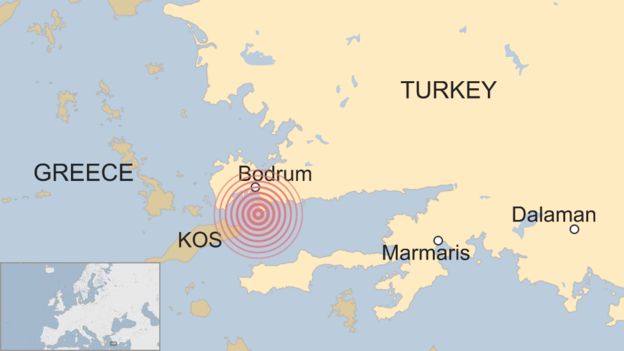
    The 6.7-magnitude quake hit 12km (seven miles) north-east of Kos, near the Turkish coast, with a depth of 10km, the US Geological Survey said.

    At least 100 others were also injured at the popular tourist destination. Some buildings were damaged.

    In the Turkish city of Bodrum, dozens of people were injured as they tried to flee the quake.

    The earthquake struck at 01:31 on Friday (22:31 GMT Thursday).

    The two deceased have not been named but police said that both victims were tourists – a 22-year-old from Sweden and a 39-year-old from Turkey.

    They died after they were crushed by debris from either a collapsed wall or an old building, police said.

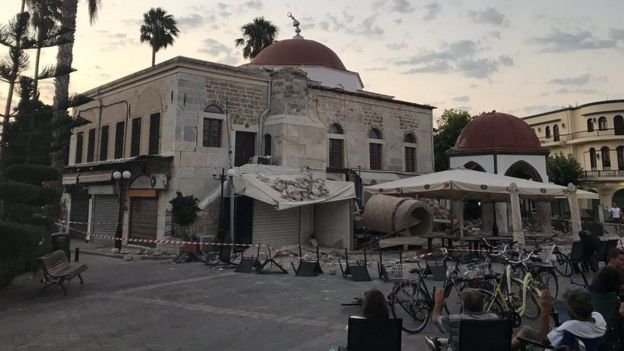
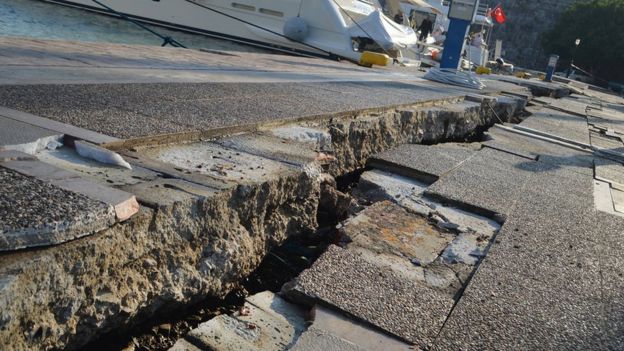
    Damage caused after an earthquake struck the Greek island of Kos, 21 July 2017REUTERS – The quake damaged a number of older buildings on the island of Kos Damage at a port on the island of Kos, Greece, following an earthquake, 21 July 2017EPA – Large cracks appeared on pathways near a port on Kos

    Dozens more were injured when buildings collapsed, some of them suffering broken bones with a number in serious condition, Kos regional government official Giorgos Halkidios said.

    The army is supporting the emergency services with the rescue operation, he added.

    'Everything was shaking'

    British student Naomi Ruddock felt the earthquake in Kos, where she is on holiday with her mother.

    "We were asleep and we just felt the room shaking. The room moved. Literally everything was moving. And it kind of felt like you were on a boat and it was swaying really fast from side to side, you felt seasick."

    Ms Ruddock said that a staff member told her it was the worst earthquake the area had seen.

    Kos was nearest to the epicentre of the quake and appeared to be the worst hit, with damage caused to a number of older buildings, including cracked walls and smashed windows.

    Earthquake damage in KosOSMAN TURANLI/SOCIAL MEDIA VIA REUTERS – Officials say some of the damaged properties may not have been earthquake-proof Tourists gather outside terminal buildings at an airport on the island of Kos following an earthquake, 21 July 2017AFP/GETTY IMAGES – Tourists headed to Kos airport after evacuating hotels and apartments

    The mayor said the buildings that suffered the most damage were built before "earthquake building codes" were introduced.

    "The rest of the island has no problem. It's only the main town that has a problem," Mayor Giorgos Kyritsis said.

    The roof of a bar on the island also collapsed, and a ferry was unable to dock due to damage at the harbour, Greek police said.

    Tourists later gathered outside terminal buildings at Kos airport having left their hotels and apartments.

    In Turkey, pictures shared on social media showed people in the city of Bodrum walking with water lapping their ankles and localised flooding, and about 80 people sought hospital treatment for minor injuries.

    Others described waking in the night after being violently shaken in their beds.

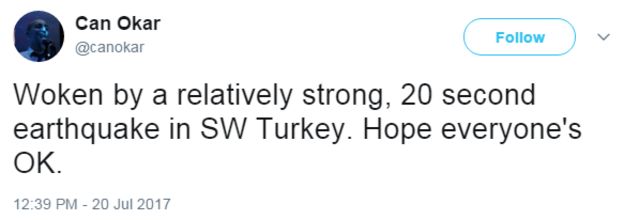
    Twitter user Can Okar writes: Image copyright@CANOKAR/TWITTER

    Kristian Stevens, a British tourist in Didim, 90km (60 miles) from Bodrum, said the building he was in began to "shake like a jelly".

    Residents fled their homes and tourists ran from holiday apartments with pillows and blankets. Some sustained injuries after jumping from windows in panic, Turkish broadcaster NTV said.

    Sophie Wild, another British tourist in Turkey, said she fled her third floor accommodation in the coastal town of Altinkum, about 800km (500 miles) from Bodrum, when she woke to a loud banging noise.

    "People were running out of rooms, banging on people's doors to make sure they were out," Ms Wild told the Press Association, adding: "Everyone just ran outside."

    At a hospital in Bodrum, the wounded were being treated in the garden as a precaution after the quake caused slight damage to parts of the hospital ceiling, the Hurriyet Daily News reports.

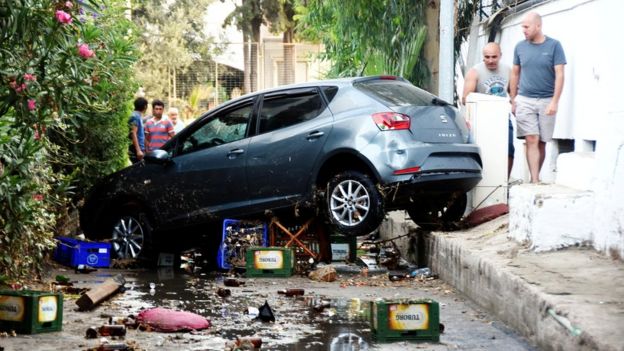
    The earthquake also triggered high waves off Gumbet, a resort town near Bodrum, which flooded roads and left parked cars stranded, Turkish media report. There were no reports of casualties.

    A car is seen after an earthquake and a tsunami in the resort town of Gumbet in Mugla province, Turkey, 21 July 2017REX FEATURES – Cars were lifted on to curbs by high waves at the resort town of Gumbet in Turkey

    Turkey and Greece sit on significant fault lines and are regularly hit by earthquakes.

    One of the deadliest in recent years hit the heavily populated northwest of Turkey, in 1999, killing some 17,000 people.

  • Can earthquakes be predicted?
  • History of deadly earthquakes
  • Map shows location of the 6.7-magnitude earthquake near the Greek island of Kos

    ___http://www.bbc.com/news/world-europe-40677825


    Source: Greece-Turkey earthquake: Two killed on island of Kos

    Saturday, July 22, 2017

    Greece and Turkey struggle in aftermath of quake that killed two

    A man looks at a car crushed under rubble near the port in Kos on Saturday. Photograph: Yannis Kolesidis/EPA

    Kos is dealing with the aftermath of an earthquake that killed two people and injured hundreds on the Greek holiday island.

    The 6.7-magnitude quake left hundreds more injured in the Turkish resort of Bodrum, about 12 miles (20km) across the sea from Kos. Tourists have faced flight delays and the damaged main harbour was closed for a second day.

    "Given the amount of people outside at the time, having only two victims is a miracle," said the deputy Kos mayor, David Yerasklis.

    The undersea quake struck at 1.31am on Friday between Kos and Bodrum, when many tourists in both places had been out enjoying the nightlife.

    At least two dead after earthquake hits Greece and Turkey

    On Kos, a wall collapsed on people in the courtyard of a nightclub, killing a 22-year-old Swedish man and a 39-year-old Turk.

    Another 120 people were hurt, seven of them seriously, while some 360 people were injured in Bodrum, many after jumping out of windows.

    The badly injured on Kos were flown to hospitals in Athens and Crete, including two men from Sweden and Norway who were in critical condition. Medics said the Swede lost his lower leg, and doctors are struggling to save his other leg. The Norwegian has serious head injuries.

    Kos is one of Greece's top travel destinations, particularly popular with British, German and Scandinavian tourists. The quake struck at the height of the tourism season.

    The Greek prime minister, Alexis Tsipras, warned against "dramatising" the issue. "Creating a climate of exaggeration and dramatisation does not help restoring normality in daily life on the island," Tsipras's office said.

    A boy stands next to a car crushed under rubble on Kos. Photograph: AFP Contributor/Getty Images

    Government officials and expert divers on Saturday were inspecting Kos's harbour, the floor of which was cracked by the tremor and has been declared unsafe for use. But the rest of island's infrastructure network including roads is mostly intact, they said.

    Ferries have been rerouted to the smaller port town of Kefalos in west Kos until repairs are made. "All scheduled ferry services are now running from Kefalos, both incoming and outgoing," a coastguard operator said.

    Many people spent the night outdoors as a precaution, setting up tents in parks and squares, but officials noted that the majority of hotels were unaffected by the quake.

    Deborah Kinnear, 35, a psychologist from Glasgow, said her family initially thought of returning home but no flights were available.

    "I think calm is being restored," she said after spending the night outdoors. "Last night wasn't too bad. Hoping the worst is over ... this has been one of our best holidays.'

    At Kos airport delays continued for a second day with more than 50 outgoing flights scheduled. About 20 flights had landed by midday on Saturday.

    "There is no problem at the hotels, the tourists have dealt calmly with developments," said Constantina Svynou, the head of the local hotelier association.

    Workers remove rubble from a quake-damaged mosque in Kos. Photograph: Louisa Gouliamaki/AFP/Getty Images

    Some areas of the port town were still without water. No injuries were reported among the 800 migrants and refugees housed on the island, which is one of the main gateways into Europe for people fleeing war and poverty. Asylum procedures have been curtailed until at least Monday as the quake damaged passport inspection facilities at the harbour.

    Many archaeological and medieval monuments, including the medieval Knights of St John fortifications near where the deaths occurred, have also been closed. The earthquake toppled the minaret of an 18th-century mosque and knocked boulders off the fortifications.

    Turkey and Greece sit on significant fault lines and are regularly hit by earthquakes. This year, Turkey's western Aegean coast has been affected by several significant tremors.

    In June, a 6.3-magnitude earthquake gutted a village on the Greek island of Lesbos, killing a woman and leaving more than 15 injured.


    Source: Greece and Turkey struggle in aftermath of quake that killed two

    Friday, July 21, 2017

    Children are forced to sleep in a park for a second night after killer earthquake struck Kos and Turkey - where thousands more Brits will arrive today as tour operators refuse ...

  • Powerful magnitude-6.7 quake has struck off the south west coast of Bodrum, Turkey, triggering a tsunami
  • Two male tourists from Sweden and Turkey killed on Greek holiday island of Kos when a bar ceiling collapsed
  • Tsunami waves flooded beachfront hotels along the Aegean coast with Bodrum and Marmaris worst affected
  • Parts of a Kos mosque collapsed into the town square, while the tremors were also felt on Crete and Rhodes 
  • Rescuers were this morning urgently searching for any more victims trapped under rubble with hundreds hurt
  • Tens of thousands of tourists have spent the night outside after being told not to re-enter their hotels
  • Collapsed pylons in Bodrum sparked huge electrical fires while power was out across much of the region  
  • Tourists told how their hotels were 'shaking like a jelly' before the tsunami sent people fleeing low ground 
  • < p class="author-section byline-plain">By Alexander Robertson and Julian Robinson and Dave Burke For Mailonline

    1

    View comments

    Tourists heading to Turkish and Greek resorts face an agonising decision about whether to go ahead with their holidays following an earthquake which claimed two lives.

    Children were tonight seen sleeping in a park following the powerful earthquake overnight on Thursday, which left more than 500 injured.

    The quake triggered a tsunami that hit resorts in the Mediterranean and Aegean Seas and damaged buildings across the region.

    Shocking pictures reveal the devastation which the natural disaster left in its wake, and the Foreign Office is warning of aftershocks.

    Scroll down for video 

    Young children were among those sleeping in a park in the island of Kos following the earthquake 24 hours earlier which caused widespread damage at the popular resort

    Families have been forced to leave their homes and sleep outdoors because of the natural disaster, which claimed two lives and left more than 500 injured

    Three young children sleep beneath the stars in a park in the Greek island following the earthquake which forced hundreds to flee their homes

    But tour operators say it is business as usual, and angry Brits have complained that companies are refusing to cancel their holidays.

    Kos International Airport reopened yesterday, and flights are expected to be unexpected to the region today.

    It comes after many holidaymakers were initially told to sleep on sunloungers as emergency services assessed the damage caused.

    A statement from Thomas Cook said: 'Customers in Kos were evacuated from hotels as a precaution and to allow an assessment of damage, but most have now been able to return . 

    'Our early inspections show that while a minimal number of properties do not currently have mains water supply and are experiencing intermittent power problems, utilities should be back to normal later today. 

    'Our quality team is also visiting hotels to check they continue to meet our health and safety standards and that, where necessary, clean-up operations are underway.

    'The impact of the earthquake was lower in Bodrum, Turkey. Our teams on the ground are visiting customers in our hotels to provide support where necessary.'

    Tourists wait outside the terminal building at the airport on the Greek Island of Kos following a 6.5 magnitude earthquake which struck the region

    Holidaymakers have been forced to wait in the open under the hot sun after being told not to go back into their hotels. This was the scene at a n airport on Kos after flights were cancelled

    At least two people are dead on the Greek holiday island of Kos and hundreds more are injured after a powerful earthquake struck off the Turkish coast. Emergency services in Kos are pictured desperately searching through the rubble

    Huge crowds were yesterday seen at Kos International Airport as holidaymakers attempted to leave the Greek island with many resorting to lying on the ground with their luggage outside the terminal.

    Experts say 29 tremors hit the affected region in the hours following the earthquake.

    The epicentre of the magnitude-6.7 quake was off Bodrum, southwest Turkey, with the country's Aegean coast and Greek holiday islands including Kos and Rhodes worst affected. 

    The Foreign Office has instructed visitors to 'be aware of the possibility of aftershocks.'

    Holidaymakers fled hotels in terror and some even jumped from balconies as the quake hit before running for their lives to higher ground as tsunami waves surged through beachfront resorts moments later, flooding bars and restaurants, carrying away cars and depositing boats in town streets.

    On the island of Kos, where a state of emergency was declared, two male tourists - a 20-year-old from Sweden and a 39-year-old from Turkey - were killed under a collapsed ceiling at the packed White Corner Club bar. Another man from Sweden has lost both of his legs, police said.

    It comes as millions of Britons are expected to head off on holiday on what is described as the 'busiest getaway weekend' of the year - but many face losing out on thousands of pounds after travel firms refused to refund trips to Greece and Turkey following the deadly earthquake. 

    Gary Taylor, le ft, is due to fly to Kos with wife Katy and daughter Summer, pictured, next week but said he wanted to cancel due to safety fears, only to be told by Thomson he 'could not have the £2,800 cost refunded due to terms and conditions' of the deal

    The minaret from Kos's most prominent mosque - the Defterdar Mosque in Eleftherias' square - lies smashed on the square below

    Yesterday Brit Gary Taylor, 51, told MailOnline he could lose almost £3,000 on a trip to Kos he wants to cancel over fears buildings in the region will not be safe.

    He said Thomson, whom he booked the holiday with, told him the region was safe and that he should continue to take his wife and daughter on the trip. 

    Mr Taylor, of Newton Abbott, Devon, said he is due to go to Kos with wife Katy and daughter Summer, 13, next week, but tried to cancel it or rearrange the destination with T homson.

    But he said he was told he could not have the £2,800 he paid refunded due to the 'terms and conditions' of his deal.

    Mr Taylor told MailOnline: 'I've been a customer with Thomson for years. A similar thing happened before with the uprising in Egypt. We went there a week later and it was the worst holiday we ever had.

    'There were armed guards everywhere and there was about 80 people in our hotel, which would usually have 1,000. 

    'I said I wanted my money back but they told me no and that it was safe. But Kos is not going to be rebuilt in a week and I asked if they could guarantee me the buildings there and my hotel were structurally sound and they couldn't. 

    'They can't guarantee me my hotel won't fall down next week. It's ludicrous to send people there a week after what happened.'

    MailOnline has contacted Thomson for comment on Mr Taylor's claims. 

    Dozens were injured - but many had to wait outside to receive medical treatment at Turkey's Bodrum State Hospital following the earthquake

    People who were sseriously injured on the island of Kos were taken to Crete for specialist treatment. A man is pictured being rushed in Heraklion

    Emergency: A woman hurt in the earthquake in Kos lies on a stretcher as she arrives in an ambulance at a hospital in Heraklion on the island of Crete

    In Bodrum, the four-star Jasmin Beach Resort was flooded by tsunami waves that spread tens of miles from the epicentre up the Aegean coast

    Locals were forced to seek cover as the earthquake occurred close to the Turkish town of Bodrum and the Greek holiday island of Kos. Pictured are staff at the main hospital in Bodru m

    The quake, which struck at 1.31am local time, was located off the coastal city of Bodrum in southwest Turkey and close to the Greek island of Kos

    Carnage: Vehicles were picked up and dumped down side streets by the force of a tsunami that swept over sea walls in the Agean coastal city of Mugla, Bodrum Province, Turkey

    A cafe setting is littered with rubble following the strong earthquake on Kos overnight. Two people were killed on the holiday island, popular with British tourists

    There have been claims today that some travel reps on Kos have been telling people to sleep on sun loungers for the rest of their stays because there are no beds left on the island. Tens of thousands had to sleep outdoors last night.

    In Britain, tourists expecting to travel this week have told MailOnline they could lose almost £3,000 on trips t hey want to cancel over fears buildings in the region will be unsafe.

    It is thought there are currently around 8,000 British tourists on Kos alone, with many more due to travel there over the next few days. But others have been left frustrated after trying to cancel their holidays only to be told they will not get a refund because the area is deemed to be 'safe'.

    There are reports in Kos that people are struggling to contact their travel representatives. One woman told MailOnline that her mother and father-in-law 'feel totally stranded' after being forced to spend all night and today outside with no word from the travel firm they booked through. 

    Amiey Westwood, 25, is in Kos on holiday with friend Danielle Blower and is due to fly home at 11.30pm on Saturday, but said she had received no information from holiday provider Thomson on whether there would be any disruption. 

    The student told MailOnline: 'We are very shaken up, our hotel room is destroyed so at the minute we don't have any where to stay tonight. We're still feeling a lot of after shocks. There are a lot of cracks in the walls and we had to sleep outside last night on some sunbeds. 

    Waiting game: Tourists found any spot of shade they could find as t hey sheltered from the hot sun during the wait for a flight off the earthquake-hit island

    There were reports that some flights off the island of Kos had been cancelled in the aftermath of the powerful earthquake

    The airport is open but staff are limiting the number of people allowed inside the building due to its small size, prioritising entry on a flight by flight basis

    Evacuation: Tens of thousands of tourists in coastal resorts have been left stranded outdoors after the quake. This was the scene in Kos where people have been told to wait outside their hotels

    Dramatic aerial photos show the damage caused to a Greek Orthodox church on the island of Kos after this morning's quake

    Aftermath: The overhead shots show how the fierce quake caused extensive damage to some buildings in Kos

    Cracks opened up on the pier at the main port on the island of Kos meaning ferries were unable to dock there today

    A man surveys the damage caused to the port on Kos after the huge 6.7-magnitude earthquake earlier this morning

    Tourists gather at a police station on the island of Kos. Mant holidaymakers have complained that they have not heard from their tour operators this morning

    'We have had no information from Thomson apart from to contact our holiday rep who is currently no where to be seen.' 

    A company spokesman said the firm was 'working closely with our teams in resort and the authorities to provide assistance to those affected. We can confirm that only a handful of TUI UK customers have suffered some minor injuries.'

    Many had woken up to scenes of carnage in Kos Town where parts of a historic mosque c ame crashing down into the street. Rescuers were this morning sifting through rubble looking for trapped survivors.

    Meanwhile, more than 270 people were admitted to hospitals in Bodrum, Turkey. Video taken when the quake hit showed staff and patients at Bodrum State Hospital cowering for cover, while the devastation caused a large electrical fire to break out in the city after a power pylon came crashing to the ground.

    Patients were being treated in the hospital garden after the facility itself was damaged.

    Tourists were forced to flee their rooms when the quake hit at 1.31am local time (11.31pm BST). They gathered anxiously in the street, and faced a sleepless night by the roadside or on beaches after they were warned not to re-enter damaged hotels. 

    Kristian Stevens, from Nelson in Lancashire said he felt the building he was in 'shake like a jelly'. The 48-year-old said he had just gone to bed when the quake struck at around 1.30am local time.

    He said: 'It was quite surreal as I had just laid down in bed and the whole building shook. The whole building shook like a jelly. 

    Treatment: A man injured in Kos is lifted from the back of an ambulance ahead of being taken into a hospital on the island of Crete

    Speaking as they arrived home on a flight from Gatwick airport Sheila Wiley said she woke up in the middle of the night to hers and 78-year-old husband Derek's entire bed shaking.

    The pair from Bristol were on their last night of a three-month stay in their Bodrum holiday home when the earthquake hit.

    Sheila, 76, said: 'It went through my head that it was a poltergeist. It was really frightening.

    'We woke up in the middle of the nig ht to the whole room was shaking and the bed was going from side to side. I have never screamed at anything in my life, but I was screaming, really screaming.

    'We realised what it was and jumped out of bed. We could hear all the Turkish people outside shouting "get out, get out".

    'There were aftershocks for hours afterwards so we didn't go back to our room for about three hours. Some people brought their mattresses downstairs and put them on the sunbeds and slept there.

    'There was another earthquake on our way to the airport this morning. We go to Bodrum for about six months out of the year and we've had earthquakes before but only small ones.

    'They were never scary, it would just be having your dinner and the table would shake. But not like this. This was terrifying.'

    Civil servant Karen Davies had to carry her elderl y parents down two flights of stairs to rescue them when the deadly quake struck.

    They were staying in an apartment on the third floor when they felt the first tremors at about 1am.

    Karen, 38, from Esher, Surrey, said: 'My whole bed was shaking. Everything was falling from the walls and shelves.

    'There were glass bottles smashing and the TV nearly came off the stand. We were right in the middle of it. People outside were screaming for us to come downstairs.'

    Karen then had to carry her parents Barry and Linda, 70, down the stairs to safety.

    She was only in Turkey because her 72-year-old dad had an accident and needed an operation.

    She said: 'We were lucky we were in our own apartment. People in hotels down the road weren't allowed to go back into their rooms. They had to spend the nig ht sleeping round the swimming pool.' 

    A woman clasps a bottle of water as she is stretchered into a hospital in Crete. She had earlier been hurt in Kos after the earthquake struck

    A woman holds a man's arm as he lies on a stretcher outisde Bodrum State Hospital in the aftermath of the earthquake

    Cars were crushed under rubble after walls came crashing down on the island of Kos. Two tourists were killed during the tremor

    Pictures show the extensive damage caused to the quay wall in Kos which appeared to break away from the harbour walkway

    A building has been roped off with cautionary tape after part of its' roof appears to have broken off and fallen down

    A damaged car and a house are seen after an earthquake in the village of Yaliciftlik near the resort town of Bodrum in Mug la province, Turkey

    As well as tourist destinations, homes and buildings further inland were hit. A woman is pictured outside a damaged house in the village of Yaliciftlik, in Mugla province, Turkey

    Panic: Dramatic CCTV footage has emerged showing terrified tourists fleeing from a restaurant as the earthquake struck in Bodrum, Turkey

    BRITONS URGED TO CONTACT INSURERS 

    Britons directly affected by the earthquake should contact their travel insurer or tour operator as soon as possible, a trade body has urged.

    Rebecca Hollingsworth, from the Association of British Insurers (ABI), said that if needed travel policies would provide cover for medical expenses linked to injuries sustained as a result.

    Some policies may also cover travel disruption.

    She said: 'Travel insurance is there to help people in circumstances like those being experienced in Greece and Turkey. Anyone directly affected is advised to contact their tour operator or travel insurer for assistance as soon as possible.'

    The ABI said people booked to go to Greece or Turkey should check the latest Foreign and Commonwealth Office advice, and talk to their tour operator, travel agent or air carrier.

    Where alternative travel arrangements are made people can usually transfer their travel insurance to cover new dates, it said.

    Policyholders should speak directly to their insurer if they have any questions, it added.

    'Many of the locals rushed out into the streets still in underwear. Some have been seen with blankets and pillows not sure if it is safe to return home.' 

    Sophie Wild said she ran from her third floor accommodation when she woke to a loud banging noise. 

    The 21-year-old from Canterbury in Kent is coming to the end of her holiday in Altinkum, around 500 miles away from Bodrum.

    She said: 'We were asleep and were awoken by what sounded like banging on our door, it got louder and louder and the building started shaking. 

    'We jumped up ran to the balcony to see what it was (my first thought when we heard the banging was that we were being attacked).

    'When we realised it was an earthquake, we got an immediate sense to get out, we thought the building was going to crumble around us. 

    'We ran down our stairs [from the third floor].

    'People were running out of rooms, banging on people's doors to make sure they were out. 

    'Everyone just ran outside and waited for a couple of hours - it's only now that people are starting to go back to their rooms. 

    'There are a few cracks in the walls but otherwise staff says it's safe.'

    Local authorities ordered holidaymakers not to enter hotels due to likely aftershocks, with more than five quakes hitting the area around Turkey in just two hours.

    The tremor struck at 1.31 am local time (11.31pm BST) approximately 6.4 miles south of Bodrum and 10 miles east of Kos. Turkey's Kandilli Observatory said the quake was followed by some 160 aftershocks, the highest measuring 4.8.

    On Kos, four people were transferred to hospitals in Crete including one from Sweden who lost both legs in the quake and another from Greece who jumped from her balcony.

    Large cracks opened up in the ground by the sea walls in Kos after the earthquake struck in the middle of the night

    Many people were forced to camp outside overnight with just blankets, sleeping on chairs and sofas that had been moved into the street

    Tens of thousands of tourists ans residents were forced to spend the night outdoors in coastal holiday resorts in Turkey and Greece. This was the scene in the Turkish city of Mugla

    Many tourists in Mugla, Turkey, were told not to go back into their hotels and spent the night sleeping under blankets and in gardens

    Aftermath: Tourists and residents survey the damage after an earthquake and tsunami shook the Turkish city of Mugla

    Hundreds of revellers were in or near the popular White Corner Club in the old town of Kos when the building partially collapsed, killing two tourists.

    Turkey's Foreign Ministry confirmed Turkish citizen Sinan Kurdoglu had died and said a second national in serious condition was being evacuated to Athens for treatment. The country has also sent a vessel to the island to bring some 200 Turkish tourists home.

    A number of flights at the airport have been cancelled while the port suffered major damage and ships are unable to dock.

    Kos Mayor Giorgos Kyritsis told state-run Greek media that buildings on the island sustained structural damage in the quake that struck early Friday morning. Witnesses described the sea 'swelling' as tidal waves crashed over the sea wall.

    Boats were smashed against seawalls as the tsunami flooded coastal roads in Bodrum province in Turkey. Thousands of tourists had to spend the night outside

    A minibus was picked up and dumped by the force of water crashing over coastal walls in Mugla in Turkey's Bodrum Province

    A man sleeps on the beachfront after spending the night outdoors following an earthquake in Bitez, a resort town about 6 kilometers west of Bodrum, Turkey, on Friday

    A powerful earthquake struck Greek islands and Turkey's Aegean coast early Friday morning, damaging buildings and a port and killing people, authorities said

    A man sleeps on a hammock after spending the night outdoors following the earthquake. Many tourists were too afraid to go back inside their hotels fearing there had been structural damage to the buildings

    One woman spent the night under a blanket lying on a sun lounger at the Marmara Club-Hotel following an earthquake in Theologos, Greece, about 20 miles from Rhodes Old Town

    A small boat is pictured washed up along a coa stal road in Kos which was flooded when the earthquake triggered a tsunami

    Shop items were tossed from shelves onto the floor at this store during the earthquake, which struck off the coast of Turkey

    Many tourists were forced to sleep outside along the roads or beaches after they were warned not to re-enter damaged hotels

    Former footballer Kevin McNaughton said he felt the quake as far away as Dalaman, around 120 miles from Bodrum.

    The former Cardiff City player tweeted: 'Jesus just experienced earthquake in turkey, literally cr***ed myself room shaking allover place, Just stood outside now no sure what to do.' 

    Among the tourists in Kos was Scottish diving instructor Christopher Hackland who described scenes of panic after the quake struck.

    'The instant reaction was to get ourselves out of the (hotel) room. There was banging. There was shaking. The light was swinging, banging on the ceiling, crockery falling out of the cupboards, and pans were making noise,' Hackland, from the Scottish capital Edinburgh told the Associated Press.

    'There was a lot of screaming and crying and hysterics coming from the hotel. It felt like being at a theme park with one of the illusions, an optical illusion where you feel like you're upside down.'

    Several tourists are stranded outside their hotel after an earthquake sent them streaming onto Lambi Beach on Kos Island.

    This was the scene in the resort town of Gumbet in Mugala province Turkey as boats lay in ruins, washed up on the shore by the tsunami 

    Cars were seen floating down coastal roads after being picked up by waves from the tsunami that hit the Greek island of Kos

    Parts of a historic mosque in Kos Town also collapsed into the street and rescuers were this morning sifting through rubble looking for trapped survivors

    Cars were carried away and buildings damaged as waves crashed over coastal roads in Kos. A car is seen with water more than halfway up the tyres

    A powerful earthquake measuring a magnitude of 6.7 has struck off the Turkish coast, triggering a tsunami in the Mediterranean and killing at least two. Pictured are damaged buildings on Kos

    Stone walls came crashing down as the powerful tremors rattled the island of Kos. Just tourists were killed when a ceiling collapsed in a nearby bar

    Two people have died on the party island of Kos, while dozens are injured as rescue crews work through the night to dig people from under the rubble of buildings

    Lauren Duffy, a 20-year-old student from Merseyside, was evacuated along with her mother and sister from the Atlantis Hotel, which was strewn with shattered glass.

    She said: 'We were asleep in our hotel room when we were woken by really violent shaking, and we all were screaming and told to evacuate from the hotel.'

    She said they were able to return to the hotel just long enough to retrieve their passports before they were forced out again by tremors.

    Ms Duffy said no one was hurt but the broken glass made the area unsafe. She said most of the stranded tourists there are Dutch, Russian and German.

    British tourists reported panicked scenes as they were woken in the middle of the night.

    Will Edmonds was staying at the Blue Lagoon resort at Lambi with his wife and two young children when he was woken 'to what I thought was a terrorist attack'.

    'The building was shaking violently and all the other guests were screaming and panicking.' 

    Travel agent Thomas Cook said this morning that all of its 2,682 British customers in Kos and 441 in Bodrum are accounted for. 

    Locals and tourists in the resort town of Bitez, southwest Turkey, spent the night outdoors after the earthquake left them too afraid to re-enter damaged buildings

    The earthquake caused several buildings to crumble on the Greek holiday island of Kos including this mosque's minaret

    Tsunami waves caused widespread damage to the port and beach areas on Kos, with an incoming ferry unable to dock

    Damage was widespread across Kos with rescuers battling to sift through rubble this morning to find any survivors

    The earthquake caused cracks in one hotel, with tourists facing a night sleeping on the beach after they were told to leave the building for their own safety

    In Bitez, a resort town west of Bodrum, the quake sent frightened residents running into the streets.

    Hotel guests briefly returned to their rooms to pick up their belongings but chose to spend the rest of the night outside, witnesses said.

    Some used sheets and cushions borrowed from nearby lounge chairs to build makeshift beds.

    Meanwhile in Rhodes, a journalist staying in Theologos, about 20 miles from the island's main town, said their hotel 'rocked like a boat and I thought it was going to collapse'.

    'We were very surprised. We were scared and we immediately went outside,' said 38-year-old Teddy Dijoux, who was holidaying with his family at a resort.

    'That lasted a long time. I quickly gathered up my children to leave the hotel,' said holidaymaker Sylvie Jannot.

    British tourist John O'Brennan wrote on Twitter: 'Just experienced 30-second earthquake.

    Tourists were forced to flee their rooms on several holiday islands and gather in the street as panic ensued in the middle of the night

    The 'violent' earthquake saw goods inside this supermarket come crashing to the floor

    'I hope there are no injuries. Building shook furiously. But all OK.'

    Tom Riesack added: 'Wow - terrifying to wake up to massively shaking room at 6.7 earthquake on Kos - thank God no one hurt, just shaken.'

    Daniel Markham, a councillor on Tonbridge and Malling Borough Council in Kent, said he too felt the effects on the Greek island of Rhodes. 

    He tweeted: '#earthquake #Rhodes felt it here too. Pretty strong. Looked out the window to see the waves in the pool.'

    The UK Foreign Office released a statement warning about the possibility of aftershocks and calling on Britons to follow the advice of local authorities. 

    It warned: 'An earthquake with a preliminary magnitude of 6.7 occurred off the coast of Kos on 21 July 2017. You should be aware of the possibility of aftershocks, and follow the advice of the local authorities and/or your tour operator.'

    Esengul Civelek, the governor of Mugla province, which contains Bodrum, said initial reports showed there were no fatalities in their region, with a small number of people suffering minor injuries.

    This photograph shows the extent of flooding by a tsunami caused by the early morning earthquake

    The Defterdar Mosque in Eleftherias' square, Kos, was among the buildings badly damaged by the earthquake with its minaret crashing into the square below (pictured left before and right after)

    HOW DO EARTHQUAKES TRIGGER TSUNAMIS? 

    The magnitude-6.7 quake triggered a colossal tsunami, leaving two dead and hundreds more injured.

    Tsunamis are generated from large and shallow quakes with an epicenter or fault line in the ocean floor.

    These tsunamis usually occur at the boundary between two tectonic plates.

    When tectonic plates brush against or collide with each other, they trigger large rumbling earthquakes.

    The tremors quickly displace large areas of the ocean floor and thousands of miles of ocean bed can be offset by a single quake.

    This displacement generates long, high sea waves, which can spread for hundreds of miles to devastate land.

    Usually, it takes an earthquake with a Richter magnitude exceeding 7.5 to produce a destructive tsunami, which explains why most tsunamis occur in the Pacific along its Ring of Fire, where large tectonic movements happen more frequently. 

    Mugla Mayor Osman Gurun said power outages affected certain parts of the province and that telephone operators experienced shortages due to overloads. 

    Bodrum Mayor Mehmet Kocadon said the earthquake had caused cracks on some old buildings.

    Turkish broadcaster NTV reported that aftershocks were being felt in the region, with a 4.6 magnitude aftershock hitting at 1.52 am (22.52pm GMT).

    The tsunami waves hit minutes after the main quake. The sea level in Bodrum dropped by almost a foot before water surges back in two powerful waves, cascading through the resorts and flooding buildings. Footage showed cars lifted up and carried away by the torrents. 

    Food and drink lies sprawled across the floor of a supermarket in the Greek island of Kos after the earthquake struck 

    Tourists in Kos Town this morning woke up to see historic buildings lying in ruins after the earthquake struck at 1.30am

    The roof of this bar came crashing down onto the streets below in Kos. Two tourists, one from Sweden and the other from Turkey, were killed in the quake

    Tsunami waves following the earthquake were strong enough to wash cars away and hit a wide area of the region dozens of miles from the epicentre 

    Numerous buildings crumbled in Kos during the earthquake (pictured), which struck off the coast of Turkey overnight

    The area surrounding Turkey is prone to earthquakes because it is located between the Arabian plate and Eurasian plate.

    This year alone, Turkey's western Aegean coast was hit by several significant earthquakes, which brought back memories of past deadly earthquakes.

    In June, a 6.3-magnitude earthquake gutted a village on the Greek island of Lesbos, killing a woman and leaving more than 15 injured. The quake also caused panic on Turkey's Aegean coast.

    On August 17, 1999, a huge earthquake measuring more than 7.0 magnitude near the city of Izmit devastated vast areas in the country's densely populated northwestern zone, notably around Istanbul, killing over 17,000 people.


    Source: Children are forced to sleep in a park for a second night after killer earthquake struck Kos and Turkey - where thousands more Brits will arrive today as tour operators refuse ...