Thursday, August 31, 2017

Cape Town City’s Manyama to leave the PSL for Turkey

CAPE TOWN – Cape Town City boss John Comitis has made good on his promise that prized asset Lebogang Manyama would not be sold to a rival PSL club but rather to a European team, with Turkish Super League side Konyaspor FC confirmed as the Bafana forward's next destination.

Manyama had been strongly linked with a move to Mamelodi Sundowns, who Cape Town City accused last season of trying to tap up another of their players, Aubrey Ngoma.

But the 26-year-old, who is the current Player and Player's Player of the Season, is instead set to test his mettle in Turkey with a Konyaspor side that finished ninth last season. Provided his medical is successful.

READ: Manyama crowned PSL Footballer of the Season

"CTCFC can confirm the transfer of Lebogang Manyama to Turkish Super League side Konyaspor FC!

"A transfer is always subject to a medical – Manyama will undergo his medical in Turkey upon the conclusion of national team duty!" the Mother City outfit announced on their Twitter page on Thursday.

Manyama, who netted 13 league goals for City last season, is with the Bafana Bafana side which will face Cape Verde in a 2018 World Cup qualifier in Praia on Friday night and again in Durban on Tuesday.

There has been no indication of Manyama's transfer fee. It has been reported however that SuperSport United, who sold the Tembisa-born player to Mpumalanga Black Aces (the club which sold its franchise to Cape Town City) will receive a cut of the transfer amount due to a buy-on clause.

AFP


Source: Cape Town City's Manyama to leave the PSL for Turkey

Wednesday, August 30, 2017

1.2m Middle East travellers head to Turkey in H1

More than 1.2 million Middle East travellers landed in Turkey in the first half of 2017, according to data released by the Turkish Consulate General Cultural and Information Office in Dubai.

During the same period, travel to Turkey has grown by ten per cent and is expected to see an estimated annual growth of 20.5 per cent by the end of the year.

Tourist traffic to Turkey from the Gulf Cooperation Council (GCC), led by travellers from Saudi Arabia, continued to show strength, rising by 26.29 per cent between January and June, as compared to the same period in 2016, or an estimated 360,000 travellers.

The number of UAE citizens and residents travelling to Turkish destinations increased by 9.86 per cent while Kuwaiti traveller numbers increased by 41.04 per cent and 31.86 per cent from Bahrain.

Growth to continue

"We expect GCC traveller traffic to Turkey to continue its strong growth over the coming six months," says Salih Ozer, Attaché of Culture and Information, Turkey to the UAE.

"Turkey continues to be a leading destination for GCC travellers due to our close cultural, religious and diplomatic ties with the region," Ozer adds.

The UAE figures are particularly striking. The first six months of 2016 saw a decrease of 20.99 per cent in traveller traffic from the UAE to Turkey. This year, that number recovered to increase by ten per cent – or more than 18,000 travellers.

The holy month of Ramadan played a big part, as UAE travel into Turkey increased by 330.33 per cent during the period.

KSA in the lead

Travellers from Saudi Arabia lead the way, with more than 205,000 holidaymakers, followed by Kuwait and Bahrain with 94,000 and 23,000 respectively.

"As Turkey's temperate summer continues to attract GCC travellers looking to get away from the desert heat, we found that business travel has also picked [up] over the past few years," continued Ozer.  "This increased intensity in travel illustrates the substantial bridge of commercial and trade links between Turkey and the region."

Top sites

The most visited site in Istanbul was the Hagia Sophia, the Orthodox basilica turned imperial mosque, which graces the city's amazing skyline. This was followed by the Sultan Ahmed Mosque – or Blue Mosque, as it's popularly known – and, finally, the Topkapı Palace, which served as the Ottman Empire's administrative headquarters in the 15th century.


Source: 1.2m Middle East travellers head to Turkey in H1

Tuesday, August 29, 2017

The EU and Turkey need each other. Could upgrading the customs union be the key?

For EU-Turkey relations, 2017 has been an annus horribilis. On both sides, calls for ending Turkey's EU membership process are mounting. Most recently, President Recep Tayyip Erdoğan called on his supporters in Germany to vote for fringe parties at the upcoming elections on September 24 to punish Turkey's so-called "enemies." Chancellor Angela Merkel and leader of the Social Democratic Party Martin Schulz—as well as the leaders of the Greens—have all become increasingly critical of Erdoğan's repressive and authoritarian politics, and Merkel and Schulz bitterly objected to what they framed as Erdoğan's blatant interference in German domestic affairs.

Merkel then upped the ante by calling for the suspension of negotiations to upgrade the customs union with Turkey. But the original customs union was not just a regular trade agreement that permitted European and Turkish industrial goods to be exchanged freely. Once the EU made its ratification conditional on Turkey adopting an initial set of democratic reforms, conditionality became a defining feature of EU-Turkish relations. This helped Turkey continue with reforms once it became an EU candidate country in 1999. Employing the principle of conditionality with the upgrading of the customs union could become a formula for recovering some of the democratic gains lost to rising authoritarianism in Turkey. A stronger customs union would benefit both sides, which need each other more than ever to manage a wide range of complex issues, from trade to counterterrorism and migration flows.

Unlikely circumstances

When the customs union was first established in the mid-1990s, Turkey's relations with Germany and the European Union were strained and Turkish democracy was the object of immense criticism from the trans-Atlantic community—similar to today in some ways.

The early and mid-1990s were marked by violence between the Kurdistan Workers' Party (PKK) and Turkish security forces, leading to massive displacement of Kurds in southeastern Turkey. Rampant human rights violations—including the imprisonment of Kurdish deputies and complete disregard for freedom of the media—prompted bitter criticism from Europe and the United States. Germany and the United States refused to sell Leopard II tanks and Cobra helicopters to Turkey, aggravating Turkey's relations with NATO as well.

The political climate was so foul that a May 1995 visit by three female Members of the European Parliament, affiliated with Germany's Green Party, infuriated then-State Minister Ayvaz Gökdemir, who famously remarked: "Turkey will never bend to pressure from these hookers."

Nevertheless, the EU and Turkey initiated and completed negotiations to adopt the customs union early in 1995. The European Parliament's ratification of the agreement was contingent on early political reforms in Turkey, which Ankara undertook. In June 1995, for instance, Turkey amended its constitution to expand political participation by removing several limitations on political party membership and decreasing voting age to 18. In October 1995, the Turkish Counterterrorism Law was amended to extend freedom of speech by switching previous jail sentences to pecuniary punishment and dropping the proposed jail time for terror charges.

Thus, the early introduction of conditionality helped set Turkey on a reform course. It eventually paved the way for Turkey to become an EU candidate country and start accession talks in 2005. The deal was not just about boosting trade and economic benefits—rather, it had concrete (and positive) political implications for Turkey.

What did it achieve?

While the customs union was being debated in the early- and mid-1990s, some in Turkey expressed protectionist concerns. Many argued that Turkish industry wouldn't be able to compete with European counterparts, for instance. Left-leaning former Prime Minister Bülent Ecevit once argued that the customs union would turn Turkey into a "market for Europeans" without much benefits for Turks; Turks, in return, would become no more than "gardeners" for them, he was reputed to have added.

But two decades later, the customs union is generally recognized to have contributed significantly to Turkey's transformation from an agrarian to an industrial economy and urban society. In the last two decades, Turkey's trade with the EU increased four-fold, making Turkey the fifth largest exporter to the EU in 2016. The EU also benefits from the customs union, as Turkey receives 4.5 percent of exports from the EU, ranking it as the fourth-largest importer from the EU—just below the United States, China, and Switzerland, but ahead of larger economies such as Japan, South Korea, and India.

The liberalization of foreign trade that the customs union also boosted Turkey's competitive power in the global economy as the country became integrated into global value chains via technical and regulatory alignment with the EU acquis—the body of EU regulations that permit market harmonization. Between 1996 and 2016, Turkey's exports to the rest of the world increased by almost five-fold, and the share of foreign trade in the country's GDP increased from 35 percent in 1995 to almost 50 percent in 2016.

What is often overlooked is that the customs union also helped Turkey take the initial steps towards democratization, and created dynamics and constituencies with an interest in democratic reform as well as help expand the middle class in the country. Without this spark, it is doubtful that Turkey would have improved its democratic credentials and expanded its democratic constituencies enough to be able to start EU membership negotiations, or become recognized as a "market economy." Turkey became a model for countries aspiring to transition to democracy and a liberal market economy—thereby enhancing the EU's transformative soft power in its neighborhood. Lastly, the customs union unintentionally became a successful migration policy tool, converting Turkey from an emigration to an immigration country. By the second half of the 2000s, there were more people migrating from Europe to Turkey than vice-versa, as Turkey became an attractive destination for European business peopl e, students, professionals, and retirees, not to mention tourists. Furthermore, the booming Turkish economy attracted migrants from neighboring countries as well as individual asylum seekers that otherwise might have been destined for the EU.

To break or not to break relations?

The picture today is very different, and the current Turkish leadership does not have its heart set on a democratic, liberal, and economically booming Turkey anymore. In hindsight, the Gezi Park incidents in 2013 and the subsequent wave of arrests and repression were a critical turning point. The collapse of peace talks with the PKK in July 2015 brought back scenes reminiscent of the ugly days of the mid-1990s. Furthermore, the emergency rule introduced after the coup attempt in July 2016 and the highly contested adoption of constitutional amendments aiming to further centralize power in the hands of Erdoğan have continued to undermine Turkey's democracy. That led the Council of Europe to put Turkey back on its monitoring list. These developments, together with the populist and religious nationalist narrative adopted by Turkey's leaders—going as far as calling measures by some European political leaders Nazis—lie at the heart of today's mutual recriminations.

Granted, the calls by Merkel and Germany's Minister of Foreign Affairs Sigmar Gabriel for freezing financial assistance to Turkey as a part of the EU pre-accession package—as well as suspending negotiations to deepen the customs union—may serve domestic political interests. Yet it is not evident that this would help to improve EU-Turkish relations, let alone salvage them. Instead, a more constructive approach would be the one adopted by European Commission President Jean Claude Juncker, who has advocated for the continued engagement of Turkey in spite of his overall opposition to Turkey's EU membership bid. Rather than risking a complete breakdown in EU-Turkish relations by suspending customs union negotiations, modernization discussions should be seen as an opportunity to re-capture the dynamism that happened on both sides.

What's at Stake

Studies suggest that upgrading the customs union to cover trade in agricultural goods, services, and government procurement would increase Turkey's GDP by 2.5 percent, along with 95 percent increase in agricultural exports to the EU and up to a 430 percent increase in the country's services exports. This would also enable Turkey to benefit from the same advantages that the EU is extending to countries with which it is signing new generation free trade agreements (FTAs), such as Canada, Japan, Korea, Morocco, Tunisia, Georgia, and Ukraine.

It would also enable Turkey to resolve some of its long-standing grievances related to the current customs union, such as undertaking the EU's Common Commercial Policy, which permits countries that have FTAs with the EU to access the Turkish market without reciprocal benefits for Turkish exports unless a separate bilateral FTA is in force. More importantly, an upgraded customs union would help boost foreign direct investment and promote innovation in Turkey, while also helping Turkey adapt to the increasing digitalization of the global economy.

The upgraded customs union could hence catalyze the growth of Turkey's competitive power and push the country above the "middle income trap." Still, such a transformation will not take place unless it is accompanied by political reforms. Several members of the Turkish government recognize this—such as Deputy Prime Minister Şimşek, who has emphasized the need for Turkey to maintain its progress on the road to EU integration—and major business associations such as TÜSİAD.

The EU has a stake in this too: It is economic as well as political. An impact study by the European Commission lays out the economic gains for the EU, including a significant increase in EU exports to Turkey and a welfare gain of 5.4 billion euros. EU companies would also gain non-discriminatory access to Turkish government's procurement market, and EU service providers (the service sector constitutes 73.4 percent of the Euro area economy) would benefit from a liberalized services market in Turkey. More importantly, starting negotiations would once more create a constructive momentum and allow stakeholders to support the successful completion of the negotiations. In such a climate, it would become easier to re-visit the need for political reforms before ratifying a deal, as Turkey will have become engaged in the project and become more committed to the pending benefits of an upgraded customs union.

The original customs union broke a vicious circle of recriminations and replaced it with an impressively virtuous one. There is no reason why it should not work once more, and if it does indeed work, it would be a win-win for the EU, Turkey, and Turkey's troubled neighborhood. At a time when the world is facing ever growing challenges, salvaging EU-Turkish relations would be a welcome step towards addressing them and protecting the international liberal order.

The opposite scenario—that is, punishing Turkey for domestic political gains at home—will only strengthen Erdoğan's hand, perpetuate his politics, and generate further regional instability and volatility, while pushing the country even closer to Russia and Iran. The United States, as a long-standing ally of Turkey and a country with a huge stake in the rule-based world order, should replicate what it did in the 1990s and help the EU and Turkey rise out of the rut they now find themselves in by advocating for negotiating an upgraded customs union.


Source: The EU and Turkey need each other. Could upgrading the customs union be the key?

Monday, August 28, 2017

Hyatt Centric Yalikavak Bodrum Hotel to Open Mid 2019 in Turkey

Hyatt Hotels Corporation (NYSE: H) today announced that a Hyatt affiliate has entered into a franchise agreement with Özkent Girisim Gayrimenkul Yatırım ve Ticaret A.S. for a Hyatt Centric hotel in Bodrum, Turkey. Hyatt Centric Yalikavak Bodrum will be managed by Access Tourism and Hotel Investment Consultancy Ltd.

Hyatt Centric

Hyatt Hotels Corporation (NYSE: H) today announced that a Hyatt affiliate has entered into a franchise agreement with Özkent Girisim Gayrimenkul Yatırım ve Ticaret A.S. for a Hyatt Centric hotel in Bodrum, Turkey. Hyatt Centric Yalikavak Bodrum will be managed by Access Tourism and Hotel Investment Consultancy Ltd. Expected to open in mid-2019, Hyatt Centric Yalikavak Bodrum will mark the fifth Hyatt-branded hotel in Turkey, joining Park Hyatt Istanbul – Macka Palas, Grand Hyatt Istanbul, Hyatt Regency Istanbul Ataköy, Hyatt Centric Levent Istanbul, and Hyatt House Gebze, which is slated to open in September 2017.

As the first Hyatt Centric resort in Turkey, Hyatt Centric Yalikavak Bodrum will boast an unbeatable location designed to be a launch pad for sightseeing, tasting and experiencing everything that the Bodrum Peninsula has to offer. Often referred to as the "St. Tropez of Turkey," the Bodrum Peninsula is one of the most popular and upscale destinations on the Turkish Riviera. The hotel will be just minutes from the famous five-gold-anchor marina Palmarina Bodrum, which offers a number of gourmet restaurants, an open-air shopping mall and entertainment venues. Hyatt Centric Yalikavak Bodrum will be easily accessible from Milas-Bodrum Airport, which offers both national and international direct flights.

Guests will enjoy premium views of Turkey's southwest coast from the hotel's 77 guestrooms with private gardens and balconies. The hotel's five food and beverage venues, which will offer both locally and internationally inspired cuisine, will capture the culinary spirit of Turkey. Hyatt Centric Yalikavak Bodrum will also offer a spa, as well as indoor and outdoor swimming pools and will be located in close proximity to an eclectic beach club. The hotel's expansive outdoor space and more than 5,850 square feet (544 square meters) of conference and events space will make for the perfect destination for weddings and events.

"Today's announcement allows us to build upon the momentum of the Hyatt Centric brand in Europe. The brand is designed for millennial-minded guests who see themselves as savvy-explorers and we look forward to the brand's continued growth throughout the region," said Peter Norman, senior vice president, acquisition and development, Europe, Africa, Middle East and South West Asia for Hyatt.

"We are very excited to announce ÖZKENT's collaboration with Hyatt to open Hyatt Centric Yalikavak Bodrum, the first Hyatt Centric beach resort in Europe, which will offer high-end vacation experiences in one of the most prime bays of Bodrum," said VARYAP's Chief Executive Officer Erdinç Varlıbaş. "With its modern Mediterranean design, artistic landscape, top seafront location and variety of offerings, Hyatt Centric Yalikavak Bodrum will quickly become one of the most sought-after hotels in the area. We look forward to continuing this a strong relationship with Hyatt in the upcoming years."

Launched in 2015, the Hyatt Centric brand includes 16 hotels in Chicago, Houston, New York City, New Orleans, Waikiki, Hawaii, Arlington, Virginia, Park City, Utah, Miami, Key West, Long Beach, Santa Barbara, San Francisco and Guatemala City, and even more in the pipeline with previously announced hotels planned for Barbados, Doha, Dubai, Madrid, French Alps, Ginza Tokyo, Peru and Santiago. 

Logos, product and company names mentioned are the property of their respective owners.

© 2017 Hotel News Resource


Source: Hyatt Centric Yalikavak Bodrum Hotel to Open Mid 2019 in Turkey

Sunday, August 27, 2017

Over 1.2 Million Middle East Travelers Land in Turkey, First Half of 2017

Travelers from Saudi Arabia lead the way with over 205 thousand holidaymakers looking to beat the summer heat

AL BARSHA, UAE - Aug. 27, 2017 - PRLog -- According to data released by the Turkish Consulate General Cultural and Information Office in Dubai, 1,226,665 Middle East travelers landed in Turkey between January and June 2017. During the same period, travel to Turkey has grown by 10%, and an estimated annual growth of 20.5% by the end of the year.

Tourist traffic to Turkey from the Gulf Cooperation Council (GCC) resident and nationals (GCC) continued to show strength, rising 26.29% as compared to 2016,

or an estimated 360 thousand travelers. The number of United Arab Emirates citizens and residents traveling to Turkish destinations increased by 9.86%. While Kuwaiti traveler numbers increased by 41.04% and 31.86% from Bahrain.

"We expect GCC traveler traffic to Turkey to continue its strong growth over the coming six months," says Salih Ozer, Attaché of Culture and Information, Turkey to the UAE. "Turkey continues to be a leading destination for GCC travelers due to our cl ose cultural, religious and diplomatic ties with the region."

The UAE figures are particularly striking. The first six months of last 2016 saw a decrease of 20.99% in traveler traffic from the UAE to Turkey, and this year recovered to increase by 10%, or over 18 thousand travelers. The Holy Month of Ramadan played a big part where UAE travel into Turkey increased by 330.33%.

Travelers from Saudi Arabia lead the way however, with over 205 thousand holidaymakers, followed by Kuwait and Bahrain with 94 thousand and 23 thousand respectively. Tourists from the UAE showed continued interest in Turkey with over 18 thousand travelers landing in the country between January and June.

"As Turkey's temperate summer continues to attract GCC travelers looking to get away from the desert heat, we found that business travel has also picked over the past few years," continued Ozer. "This increased intensity in travel illustrates the substantial bridge of commercial and trade links between Turkey and the region."

The greatest increase in the Gulf countries is observed in Kuwait as always. Kuwait, which is the Gulf country that sends the most tourists to Turkey after Saudi Arabia every year, closed this year with an increase of 41.04%, over 94 thousand people over the same time period.

Flights from Kuwait did not only head towards the traditional destinations such as Istanbul and Antalya, but to alternative ones such as Bursa and Izmir. "We organized a tourism workshop in Kuwait this year to develop tourism relations between our country and Kuwait. We met with local tourism sector representatives to discuss the challenges and opportunities."

Similar to last year, Bahrain so far this year saw traveler traffic grow by 31.86%, or about 24 thousand people. "We see serious demand for Turkey in Bahrain and we are working to reinforce our cultural and tourism ties by organising activities like workshops and Turkish Food festivals,:" he concluded.

The most visited site in Istanbul was the Hagia Sophia, the Orthodox basilica turned imperial mosque, which graces the city's amazing skyline. That was followed by the Sultan Ahmed Mosque or Blue Mosque as it's popularly known, and finally, the Topkapı Palace that served as the Ottman Empire's administrative headquarters in the 15th century.

End


Source: Over 1.2 Million Middle East Travelers Land in Turkey, First Half of 2017

Saturday, August 26, 2017

Middle East travelers to Turkey grow 10% in H1

DUBAI – According to data released by the Turkish Consulate General Cultural and Information Office in Dubai, 1,226,665 Middle East travelers landed in Turkey between January and June 2017. During the same period, travel to Turkey has grown by 10%, and an estimated annual growth of 20.5% by the end of the year.

Tourist traffic to Turkey from the Gulf Cooperation Council (GCC) resident and nationals (GCC) continued to show strength, rising 26.29% as compared to 2016, or an estimated 360 thousand travelers. The number of United Arab Emirates citizens and residents traveling to Turkish destinations increased by 9.86%. While Kuwaiti traveler numbers increased by 41.04% and 31.86% from Bahrain.

"We expect GCC traveler traffic to Turkey to continue its strong growth over the coming six months," said Salih Ozer, Attaché of Culture and Information, Turkey to the UAE. "Turkey continues to be a leading destination for GCC travelers due to our close cultural, religious a nd diplomatic ties with the region."

The UAE figures are particularly striking. The first six months of last 2016 saw a decrease of 20.99% in traveler traffic from the UAE to Turkey, and this year recovered to increase by 10%, or over 18 thousand travelers. The Holy Month of Ramadan played a big part where UAE travel into Turkey increased by 330.33%.

Travelers from Saudi Arabia lead the way however, with over 205 thousand holidaymakers, followed by Kuwait and Bahrain with 94 thousand and 23 thousand respectively. Tourists from the UAE showed continued interest in Turkey with over 18 thousand travelers landing in the country between January and June.

"As Turkey's temperate summer continues to attract GCC travelers looking to get away from the desert heat, we found that business travel has also picked over the past few years," continued Ozer. "This increased intensity in travel illustrates the substantial bridge of commercial and trade links between Turkey and the region."

The greatest increase in the Gulf countries is observed in Kuwait as always. Kuwait, which is the Gulf country that sends the most tourists to Turkey after Saudi Arabia every year, closed this year with an increase of 41.04%, over 94 thousand people over the same time period.

Flights from Kuwait did not only head towards the traditional destinations such as Istanbul and Antalya, but to alternative ones such as Bursa and Izmir. "We organized a tourism workshop in Kuwait this year to develop tourism relations between our country and Kuwait. We met with local tourism sector representatives to discuss the challenges and opportunities."

Similar to last year, Bahrain so far this year saw traveler traffic grow by 31.86%, or about 24 thousand people. "We see serious demand for Turkey in Bahrain and we are working to reinforce our cultural and tourism ties by organizing activities like workshops and Turkish Food festivals,:" he concluded.

Th e most visited site in Istanbul was the Hagia Sophia, the Orthodox basilica turned imperial mosque, which graces the city's amazing skyline. That was followed by the Sultan Ahmed Mosque or Blue Mosque as it's popularly known, and finally, the Topkapı Palace that served as the Ottman Empire's administrative headquarters in the 15th century. — SG


Source: Middle East travelers to Turkey grow 10% in H1

Friday, August 25, 2017

The top 5 cheapest all-inclusive holiday destinations for Brits this summer

If lying on a beach, sipping on cocktails and soaking up the rays sounds like your dream holiday, then an all-inclusive resort could be just the ticket.

In fact it can prove to be more budget-friendly than paying for your flights, beachside hotel, restaurants and activities - especially if you're travelling with the kids who'll need entertaining every day.

It's becoming an increasingly popular option for Brits too. The Association of British Travel Agents says one in four families are opting for an all-inclusive package this year, compared to less than one in five in 2016.

With some brilliant deals coming in at just as little as around £200 per person for a week's holiday, there's no denying that it can be the ideal way to get the most out of your money.

TravelSupermarket conducted some research into the best all-inclusive packages on offer for Brits this summer, and now they've revealed the top 5 destinations that proved to be the cheapest.

From Greece to Majorca, check out the sun-soaked getaways that are sure to make for an unforgettable, cheap summer holiday...

1. Alanya, Turkey Alanya, Turkey (Image: Photononstop RM)

You're sure to be treated to some gloriously warm weather over the summer, when temperatures can go as high as 31 degrees, dropping to just 21 degrees at night - perfect if you want to enjoy a spot of outdoor dining!

There are plenty of brilliant all-inclusive, resorts in Alanya that boast a rating of 3-star and above, going for as little as £170 per person for a week.

For example, if you travel to the 3-star Pekhan Hotel in Alanya from Gatwick, you can get prices as low as £173 per person for a week, while the 4-star Anitas Hotel costs as little as £196 per person for a week if you travel from Newcastle in June.

Check out the deals on offer at TravelSupermarket here . If you are travelling to Turkey make sure to check the Foreign Office's Travel Advice before you book.

Read More Read More 2. Rhodes, Greece The view of Pallas Beach (Image: LOOK)

According to TravelSupermarket data, there's been a surge of interest in mainland Greece and its islands, with interest in Santorini up by 149%, Zakynthos/Zante up by 239%, and Rhodes up by 47%.

It's not a huge surprise - Greece is regularly coming up as a cheaper alternative to Spain, even when travelling from regional airports.

However, it's the island of Rhodes that's proving to offer the best all-inclusive prices, with prices around £192 per person for a week this summer.

For example,you can stay in the Loutanis Hotel in Kolymbia for a week in June at £192 per person.

If you fly from regional airports including Birmingham, Liverpool, Leeds and Newcastle the prices are slightly higher, but come in at under £300 per person.

If you do manage to tear yourself away, the medieval Old Town has some picturesque cobbled streets, a castle and elegant mansions - not to mention the idyllic town of Lindos is also well worth a visit.

Check out the deals on offer at TravelSupermarket here .

Read More Find a travel bargain Read More 3. Majorca, Balearic Islands People on Palma Nova Beach in Majorca (Image: Getty)

If Spain is top of your summer holiday wishlist, you may want to ditch the mainland and head to the Balearic Islands instead. For all-inclusive deals, it's Majorca that continues to lead the charge.

The flight time is just over two hours and the season lasts all the way through to October, so it's ideal whether you're travelling during the school holidays or don't have kids and want to wait until September to bag a holiday bargain.

The island has everything from crystal-clear waters and sandy beaches to scenic walking trails and breathtaking natural sights from the Artà caves to national park Cabrera (just a short boat trip away).

Travel in September departing from Southend or Luton and you could spend a week in the 3-star Hotel Mix Alea in El Arenal with prices from £202/£204 per person, or from £222/£233 if you're flying from Liverpool or Manchester.

Check out the deals on offer at TravelSupermarket here .

Read More Read More 4. Sunny Beach, Pomorie and Burgas Bay, Bulgaria Sunny Beach on Bulgaria's Black Sea coast

If you fancy affordable sun and sand - and cheap beer - then Burgas Bay, Pomorie and Sunny Beach on the Black Sea coast in Bulgaria could be perfect for you.

The region gets an average of nine hours of sunshine a day in September, not to mention there are over 18 UK airports included in holiday packages there.

There's plenty of culture on offer too if you're looking for a day excursion, with places like UNESCO-listed Nessebar - one of the oldest towns in Europe - just a short drive away, or Pomorie's awe-inspiring Roman tombs and medieval monastery.

If you're heading to Sunny Beach for a week, then prices for a 3-star all-inclusive holiday tend to start from £208 per person.

For example, fly from Gatwick and stay at the Sunny Bay Hotel near Pomorie for £214 per person for the week, or from £284 each from Manchester.

Meanwhile, head in June with a flight from Edinburgh and you could spend a week at the Hotel Yunona from just £306 per person.

Check out the deals on offer at TravelSupermarket here .

Read More Read More 5. Tenerife (Image: AWL Images RM)

The largest of the seven Canary Islands, Tenerife is also the most diverse with everything from water parks to tranquil beaches, cultural fishing ports and streets packed with clubs and bars.

The best part is it's just a few hours' flight so you can quickly get to the sandy golden beaches, glorious sunshine and crystal-clear waters.

Despite its popularity with Brits, Tenerife still remains one of the top 5 places offering up the cheapest all-inclusive packages, with plenty available for less than £250.

For example, fly from Leeds Bradford in June and stay at the 4-star Elegance Dania Park for £242 per person for a week, or depart from Manchester Airport and stay at the same resort for £247 per person.

Check out the deals on offer at TravelSupermarket here .


Source: The top 5 cheapest all-inclusive holiday destinations for Brits this summer

Thursday, August 24, 2017

A celebrity destination guide for Eid Al-Adha

STILL thinking of where to go this Eid Al-Adha? Wego.ae, the largest travel marketplace in the Middle East, took some cues from some of the region's most famous personalities and celebrity Instagram accounts for some suggestions.

"As Eid Al-Adha approaches we scoured some of the more popular celebrity Instagram accounts for some destination inspiration, and we're certainly not disappointed," said Mamoun Hmedan, managing director of Wego Middle East, North Africa and India.

"We were particularly motivated by Crown Prince Sheikh Hamdan Bin Mohammed who shows what an adventurer he is," Hmedan said. "From the Scottish Highlands to hiking to the top of the Half Dome at Yosemite National Park, the Prince is an avid explorer and great photographer as his Instagram attests to."

"Joelle Mardinian, television host and brand ambassador, clearly loves the French Riviera, and social media funnyman Abdullaziz Baz who travels through Zanzibar, Tanzania, Austra lia and more mixes some great personality into his destination shots," he added.

"We found photographer and social media star, Lulwa Al Khataf's inspiring journeys through the Maldives, Oman, Malaysia and Paris particularly enticing, and host and brand ambassador Logain Omran had us checking out flights to the Seychelles with her recent Instagram snaps."

"Haifa Beseisso had us adding the Dominican Republic, India's Kerala, and Tokyo to our list, and Dubai restaurateur and foodie, Taim Alfalasi added Turkey's Antalya and New York. In addition, menswear and lifestyle specialist, Elias El-indari took our breath away with his shots atop Glacier 3000 in Diablerets, Switzerland," said Hmedan.

Other adventurous Instagrammers extended Wego's destination list even more and the team bought some larger suitcases after checking out Style presenter, Aline Watfa's attendance at Paris Fashion Week, and Mariam Said's dreamy pictures of Tuscany spiked discussi on about whether the team would ever return to the office.

"If we discovered anything in seeking destination ideas for Eid Al-Adha, apart from a very long list of inspirational Instagram accounts, it's that we all see the world through unique eyes and discovery is but a plane journey away," concluded Hmedan.

Wego.com provides award winning travel search websites and top ranked mobile apps for travelers living in the Asia Pacific and Middle East regions. Wego harnesses powerful yet simple to use technology that automates the process of searching and comparing results from hundreds of airlines, hotels and online travel agency websites.

Wego presents an unbiased comparison of all travel products and prices offered in the marketplace by merchants, both local and global, and enables shoppers to quickly find the best deal and place to book whether from an airline or hotel direct, or with a third party aggregator website .

Wego was founded in 2005, is dual-hea dquartered in Dubai and Singapore and is backed by investors including Tiger Global Management, Crescent Point Group and SquarePeg Capital, and MBC Group – the Middle East's largest media organization. — SG


Source: A celebrity destination guide for Eid Al-Adha

Wednesday, August 23, 2017

European Summer Destinations – Greece, Turkey and Croatia

....................................................................................

Summer destinations are all about having adventures and enjoying the sun on beaches. European countries have the right combination as fabulous summer destinations with their moderate climate conditions. Although Europe's size is about the quarter of Asia's size and the third of Africa's, Europe is a major tourist attraction. One reason is the adoption of the Euro in 1999 which facilitates moving around European countries with ease. As summer is the busiest tourism season in Europe, book your hotel room beforehand. Then prepare your sunglasses and sunscreen for blocking harmful UV radiation and looking awesome.

Greece

Do you want to enjoy a summer destination with Mediterranean climate, lots of fun and all of it at an affordable cost? Greece is the European country of choice for many tourists who are stunned by the beauty of this ancient land that is young at heart. Beaches of Greece are advantaged by having silky white sands and by being located on the sapphire blue waters of the Aegean, Ionian, Mediterranean Seas and the Sea of Crete. While in Greece, you'll get to savor its delicious cuisine while watching or even participating in the sirtaki dance. For enjoying marvelous scenery, visit the volcanic island, Santorini, and observe the spectacular sunset.

Turkey

Turkey might not be a part of the European Union; however, Turkey represents a an ideal summer destination with its pretty beaches and historical sites. Turkish coastal region on the Mediterranean is home to prominent summer resorts, as the Black Sea region includes a choice of untouched beaches and fishing villages. The most unique place to visit in Turkey is Istanbul as it is the only city that lies both in Europe and Asia. Istanbul merges beauty of the East and the West. Turkish mouthwatering cuisine is distinguished from other European cuisines by having dishes such as doner, kebab and kofte.

....................................................................................

....................................................................................

Croatia

The European Union recently let Croatia join it. Croatia is gaining a high popularity among European tourists as well as American ones. The beaches of Croatia are rocky but that doesn't stop tourists from jamming them up. Beaches of Croatia, like Dubrovnik, are the major attractions for those looking for a summer destination. However, the country is filled with other attractions such as ancient churches, medieval and ancient Greek architecture.

Greece

Greece European Summer DestinationsGreece European Summer DestinationsGreece European Summer DestinationsGreece European Summer DestinationsGreece European Summer Destinat   ionsGreece European Summer Destinations

Turkey

Turkey European Summer Destinations Turkey European Summer Destinations Turkey European Summer Destinations Turkey European Summer Destinations Turkey European Summer Destinations Turkey European Summer Destinations

Croatia

Croatia European Summer DestinationsCroatia European Summer DestinationsCroatia European Summer DestinationsCroatia European Summer DestinationsCroatia European Summer DestinationsCroatia European Summer Destinations

ADVERTISEMENT ///////////////////////////////////////////

(Visited 577 times)


Source: European Summer Destinations – Greece, Turkey and Croatia

Tuesday, August 22, 2017

Destination Turkey for Vikram

Chennai: Vikram is all set to leave for Turkey to shoot some important scenes for his forthcoming action thriller Dhruva Natchathiram.

The cast includes Vikram, Aishwarya Rajesh, Rithu Verma, Simran, Radhika, Parthiban, Sathish, Vamsi and Munna.

The movie has music by Harris Jeyaraj. Much recently the crew shot the movie in four countries in virgin locations.

Directed by Gautham Meneon, the flick is said to be an investigative thriller. Vikram appears in salt and pepper style. Initially Vijay was supposed to play the lead in the movie. However the actor declined and the baton was passed to Vikram.

Plans are on to release the movie by this year-end. Gautham Menon is also directing Dhanush for a movie titled Enai Nokki Payum Thotta.

Related Post

No to hybrids but yes to elect... Promising players come to lime... Kaspersky lab finds year-old A... Arya to act in Kannada movie
Source: Destination Turkey for Vikram

Monday, August 21, 2017

Global Ports in the doldrums as cruises shun Turkey

Unrest in Turkey spurred a near-tripling of first-half pre-tax losses at Global Ports Holding after a decline in cruise ships docking at its ports in the country.

Shares in the port operator, which floated in May and counts Peter Mandelson, the Labour peer and former EU trade commissioner, as a board member, closed down 10 per cent on Monday on the news.

Passenger numbers at GPH's port in Kusadasi, a resort town in western Turkey, sank 63 per cent in the six months to June 30 compared with the same period last year. The slump came after cruise operators switched routes to visit Greek islands instead of Turkish destinations, the company said on Monday.

This was "unexpected" and driven by a "negative perception of Turkey among foreign tourists" because of "geopolitical tension", GPH said.

Turkey's tourism industry has struggled as a result of terrorist attacks and political instability, including an attempted coup, that have deterred holidaymakers from visiting the country. This month tour operator Tui said security-conscious tourists were shying away from travel to north Africa and the eastern Mediterranean in favour of core European destinations.

Emre Sayın, chief executive, remained bullish, however, saying that GPH planned to expand its number of ports through acquisitions in the Caribbean and Asia, and so reducing "the significance of our Turkish cruise port operation to our overall business".

He added: "Our M&A pipeline of international cruise ports remains strong with progress being made on a number of our target acquisitions." The company raised £58m in its flotation, some of which was intended to finance acquisitions.

GPH reported half-year pre-tax losses of $6.5m, up 179 per cent on a year earlier, as revenues slipped 6 per cent to $49.8m. The group said profit margins were relatively high at the Turkish ports, and that the decline there was offset by higher passenger numbers at its other ports and a strong performance at its commercial business.

The company was pushed to a loss by its $10.9m of net finance costs, up 4 per cent on a year earlier, which mainly comprised interest on its $215m of net debt. The company was also hit by $3m in expenses related to its IPO.

Revenues from cruise operations were down 15.9 per cent year on year to $18.5m, while the cargo business fared better, revenue rising 1.6 per cent to $31.3m in the six months.

The group said it expected a recovery in Turkish cruise passenger numbers only in the "midterm" and that it had a "cautious" outlook for the remainder of the year.

GPH started as the operator of Port Akdeniz, a general commercial port in Antalya, Turkey. But it has developed rapidly as a holder of concessions to operate cruise terminals at facilities in Turkey and eight other countries including Portugal, Italy and Singapore.

It is majority owned by the Turkish company Global Investment Holdings and has a free float of 34 per cent.

The shares closed at 612p, giving GPH a market cap of £385m.


Source: Global Ports in the doldrums as cruises shun Turkey

Sunday, August 20, 2017

British actor Larry Lamb to promote Turkey in TV show

A travel program featuring Turkey's popular tourist destinations and historical attractions will be aired on a U.S.-based television network over the next three years, Turkey's Tourism Ministry said Sunday.

Famous British actor Larry Lamb and his son George Lamb, a well-known radio programmer, will promote Turkey's tourist attractions in a six-episode program titled "Turkey: A to B" on Travel Channel, according to a written statement.

A 10-member team completed the shooting in 24 days, it said, adding the program would feature popular tourist destinations, including historical and cultural spots in Istanbul, the antique city of Ephesus in Izmir, Cleopatra pools in Pamukkale, Phaselis antique city in Antalya, Cappadocia hot air balloon rides and Ankara Citadel.

The program, which is expected to boost Turkey's tourism sector, will be available for viewing in the United Kingdom, Middle East, Europe and Africa as part of an agreement between the Ministry and Travel Channel, which has 61.4 million subscribers and broadcasts programs in 22 different languages in 74 countries, the ministry added.

The statement did not specify when the first episode would be aired.

Turkey remains one of the most popular tourist destinations in the world, with revenues from tourism playing a vital role in its economy.


Source: British actor Larry Lamb to promote Turkey in TV show

Saturday, August 19, 2017

Sri Lanka Proposes Preferential Trade Agreement With Turkey

Sri Lanka has proposed a Preferential Trade Agreement (PTA) with Turkey to strengthen economic relations between the two countries.

On the invitation by the Embassy of the Republic of Turkey in Sri Lanka a Ministerial Delegation led by the Sujeewa Senasinghe, State Minister of International Trade together with the representatives from Board of Investment (BOI), Joint Apparel Association Forum (JAAF) and Sri Lanka Export Development Board (EDB) visited Turkey to attend meetings related to trade and investment promotions.

The State Minister held very productive meetings with trade chambers in Ankara, Istanbul and Izmir in addition to attending the Izmir International Fair. Investments and Sri Lanka's entry into the Turkish Market are stated as at the top of his agenda.

"As our bilateral trade grows I invite the prospective Turkish investors to invest in Sri Lanka. We have allocated 20,000 acres for 5 free trade zones of which the first will be opened at Kalutara District. Also investors could gain immediate access to the South Asia's huge market through us," Sujeewa Senasinghe said while addressing the Ankara Chamber of Industry.

Sri Lanka and Turkey took stock of all exports and investment engagements especially in textile, tea and boat building sectors. One of the major highlights of the State Minister's visit was his effort to introduce Sri Lanka's new products to the Turkish Market.

Turkey is the 16th export destination for Sri Lanka and accounted for 1.5% of total exports from Sri Lanka in 2016. Total export value from Sri Lanka to Turkey was US$ 154Mn in 2016 and total imports from Turkey to Sri Lanka for the same period was US$ 69Mn.

Sri Lanka's main export products to Turkey in 2016 were tea (value added and bulk), woven fabrics, apparel, pneumatic tyres, activated carbon, coco peat and fiber pith, desiccated coconut, industrial and surgical gloves of rubber and essential oil. The main import products from Turkey were electric machinery, animal fat, leather, processed food, woven fabric, cotton during the same year.


Source: Sri Lanka Proposes Preferential Trade Agreement With Turkey

Friday, August 18, 2017

Sri Lanka to enter into PTA with Turkey

On the invitation by the Embassy of the Republic of Turkey in Sri Lanka, a ministerial delegation led by Sujeewa Senasinghe, State Minister of International Trade together with the representatives from Board of Investment (BOI), Joint Apparel Association Forum (JAAF) and Sri Lanka Export Development Board (EDB) are currently in Turkey attending meetings related to trade and investment promotions.

The delegation will also attend the 86th Izmir International Fair opening ceremony and seminar program. State Minister was awarded a ceremonial welcome by the Minister of Trade and Customs and Deputy Minister of Economy in Turkey.

He held very productive meetings with trade chambers in Ankara, Istanbuland Izmir in addition to attending the Izmir International Fair.

.He has proposed to initiate Preferential Trade Agreement (PTA) with Turkey's aggressive attempts to strengthen economic relations between two countries.

The two parties took stock of all exports and investment engagements especially in textile, tea and boat building sectors.

Turkey is the 16th export destination for Sri Lanka and accounted for 1.5% of total exports from Sri Lanka in 2016.

Total export value from Sri Lanka to Turkey was US$ 154Mn in2016 and total imports from Turkey to Sri Lanka for the same period was US$ 69Mn.


Source: Sri Lanka to enter into PTA with Turkey

Thursday, August 17, 2017

There's something about Turkey

A drop in tourism shaved off nearly 1% of Turkey's GDP in 2016 - but visitors are beginning to return

"But is it really safe to go to Turkey?" That's the question being asked again and again by holiday-hungry travelers looking for their next destination.

And the question makes sense. In the past few years, Turkey has suffered a wave of terrorist attacks and seen a failed military coup with a hard-hitting government response. The country is going through political and economic instability -- echoing in all levels of society. And scaring off tourists from around the world.

But there's something about Turkey. About the history there. The mountains, the water, the food, the atmosphere. And after a deep crisis, visitors are slowly starting to return.

Bianca Zanini

CRISIS

The country's domestic turmoil has hit the national tourism industry - and economy - hard. And the government of Antalya - Turkey's resort and tourist heaven - and Turkey's Ministry of Culture and Tourism are working hard to change that.

In 2016 the number of tourists visiting Turkey dropped by nearly one third to about 25 million. The crisis shaved off nearly 1% of Turkey's GDP in 2016.

And despite all it has to offer, Turkey, and Antalya in particular, is now forced to compete with other destinations that have become popular in recent years - like Greece, and Malta.

"Comparing to Greece, I do not see any huge difference. The weather is quite similar, the kitchen also", says a Polish tourist travelling in Antalya with his wife and two children.

Bianca Zanini

Fighting Fear

They came here for the low prices and all-inclusive resorts. And that is where they stay – almost exclusively:

"We are a family with two children, we would like to not take a high risk, so we stay in the hotel".

With 60% of its economy dependent on tourism, Antalya is an area dependent on its visitors feeling satisfied and welcome.

But just like the rest of Turkey, Antalya is fighting against a sense of insecurity and fear -- sometimes even from the tourists that do choose to go.

Bianca Zanini

Terror and Tourism

2016 was a year of monthly terrorist attacks in Turkey. And although the number of attacks fell drastically in 2017, - at least so far - just this week a policer officer was stabbed to death at a police station in Istanbul by a man affiliated with Islamic State and who was allegedly suspected of planning a suicide bombing.

Several foreign governments, including the UK, Denmark and Israel have issued travel warnings for Turkey.

Still, traffic continues to be a lot more dangerous than terrorism in Turkey - and in Antalya the streets are being surveilled by undercover police and guards.

"Antalya or Turkey is not much [more] dangerous than Jerusalem, or other world cities, London, Berlin, or New York. It's SAFE", says Osman Ozbuldu, a tour guide in Antalya.

"If we are scared, we terrified for our own lives. We should be courageous and the terrorists won't win. We were in Antalya street yesterday, you didn't see much policemen. They control and make Antalya secure enough".

Bianca Zanini

The Russians are Returning

The number of Russian visitors especially plummeted after the diplomatic crisis that took off in November 2015, when Turks shot down a Russian warplane. Before, 1 in 10 visitors to Turkey were Russians. But by May 2016, just six months later, the number of tourists from Russia had dropped 92 percent.

Feride Koray, the Guest Relations Agent at the Legend Hotel, says things are starting to turn around.

"With the Russians guests, yes it's true that it is much [more] less than in the previous years. But it's getting better and better".

The Legend Hotel offers a unique experience for children and their parents - everything from cartoon characters and dressed-up dancers serving candy to water shows with dolphins and wall-to-wall screens featuring live images of visitors and CGI-animals.

About an hour away is the historic town of Side, known for its long beaches and the beautiful Greco-Roman ruins. The remains of a 2nd-century theater which seated up to 15,000 people is side-by-side with a small pedestrian street, filled with small shops, local food and tasty ice-cream.

Mehmet Kuhtlu owns a bag shop there, and he has felt the drop in tourists.

"Last year [there were] almost no Russian people here, because the Russians listened to the Government. But this year [the governments] have good connections again, and it's good for the tourism."

A little of everything

Antalya is both a city and a region - and whether you prefer to lie on a beach, dive, hike, shop or visit historical sites, you can find it there. Often with a little cup of black Turkish coffee. The old town has a unique atmosphere and look, resembling the small romantic streets of Rome with a Middle Eastern twist. It offers a vibrant nightlife with live-music, alcohol and sometimes even pools inside of the bars.

And things are slowly starting to turn around for Turkey's tourism industry. According to the Turkish Statistics Institute, the country's tourism revenue grew by 8.7 percent during the second quarter of this year. But even if Turkish tourism does rebound this season, the industry continues to be burdened with about 17 billion dollars in debt.

The political reality facing Turkey right now is complicated. Many foreigners are worried about going there - making it less alluring. And yet, tourists are starting to return to Turkey. Perhaps it's the breathtaking beaches and mountains, or simply the low prices. Or the wide range of all-inclusive resorts for all ages and tastes. Either way, there seems to be something there.

Bianca Zanini

Through the Governor of Antalya and the Turkish Embassy in Israel, our International Affairs Correspondent Bianca Zanini was invited with a group of journalists to visit Antalya.


Source: There's something about Turkey

Wednesday, August 16, 2017

What is the Hit Destination for Citizens of BiH this Summer?

The absolute hit destination for citizens of Bosnia and Herzegovina this summer is Turkey, while fewer citizens of BiH are spending their vacation in Croatia," according to data from tourist agencies from Sarajevo, Banja Luka and Mostar.
"The increase of the sales arrangements for Neum was recorded this year, but Montenegro and Greece were quite requested as well," said the director of Centrotrans Muamer Lutvic, adding that there were fewer requests for Croatia in comparison to last year.

A representative of Kompas-Tours from Banja Luka Visnja Racic said that citizens of Banja Luka prefer Greece this year, but they received a large number of requests for Turkey as well.

Director of NikkiTravel Agency from Mostar Nikica Demirovic noted the southern part of Italy and the Black Sea as a great surprise of this year.

From the Jungle Travel Agency stated that citizens of BiH are mostly going to Sri Lanka, Zanzibar, Bali and Thailand when it comes to more distant destinations.

(Source: fokus.ba)


Source: What is the Hit Destination for Citizens of BiH this Summer?

Tuesday, August 15, 2017

Tillerson calls out Turkey, Bahrain, Saudi Arabia & Iran over religious freedom

US Secretary of State Rex Tillerson has singled out several Muslim-majority countries for violating religious freedoms. He also called out Islamic State (IS, formerly ISIS) terrorists for their "genocide" of Yazidis, Christians and Shia Muslims.

Tillerson has accused friends and foes alike of violating their citizens' religious freedoms, particularly focusing on Muslim-majority countries in his presentation of the US State Department's annual report on religious freedom worldwide.

The US's top diplomat said Bahrain and Saudi Arabia "must" stop discriminating against their Shia community.

In Saudi Arabia, "the government does not recognize the right of non-Muslims to practice their religion in public, and applied criminal penalties, including prison sentences, lashings and fines for apostasy, atheism, blasphemy and insulting the state's interpretation of Islam," Tillerson said.

In Turkey, authorities continue to limit the human rights of members of some religious minority groups, he said.

Bahais, Christians, and others minorities are persecuted for their faith In Iran, Tillerson charged, adding that the Islamic Republic "sentences people to death on vague apostasy laws."

In addition to governments, the secretary of state also called out terrorist groups, particularly the Islamic State (formerly known as ISIS/ISIL), which he said was "clearly" responsible for genocide against Yazidis, Christians, and Shia Muslims in the parts of Syria and Iraq it controls.

Producing an annual report about the state of religious freedom around the world has been the State Department's obligation under a 1998 law. The report to Congress is part of America's push to "promote religious freedom as a moral imperative," the State Department said in a statement.

Read more

Supreme Court to hear Trump travel ban case, allows part to go into effect

In May, Trump delivered a speech about religious tolerance during his visit to Saudi Arabia, his first foreign destination as president.

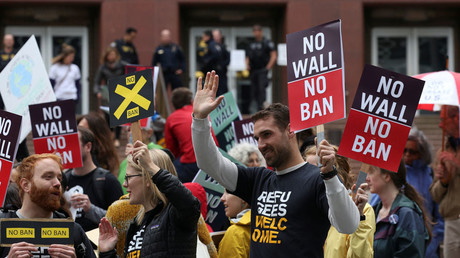
However, Muslim-American groups have accused the Trump administration of stoking hate and fear of Muslims inside the US. Organizations such as the Council on American-Islamic Relations (CAIR) have called Trump's restrictions on travel from six predominantly Muslim countries discriminatory and bigoted against Muslims.

During his election campaign, days after a terrorist attack in San Bernardino, California in December 2015, Trump called for "a total and complete shutdown of Muslims entering the United States until our country's representatives can figure out what the hell is going on."

In January, Trump signed an executive order banning refugees from all countries and severely restricting travel into the US from six predominantly Muslim nations: Syria, Iran, Libya, Somalia, Sudan and Yemen.

The administration cited a strong terrorist presence in most of the countries on the list. Both the original ban and the updated order issued in March were blocked by federal judges, but the US Supreme Court allowed a limited version of it to go into effect pending a hearing in October.


Source: Tillerson calls out Turkey, Bahrain, Saudi Arabia & Iran over religious freedom

Sunday, August 13, 2017

Wet weather drives Brits to last-minute August holidays in sunny destinations

British families are paying extra to visit hotspots in Turkey, Greece and Spain after the UK suffered wettest July for five years, thesun.co.uk reports adding that fed-up Brits are fleeing the wet weather to grab last-minute holidays in the sun.

Travel firms announced bookings are at more than double this time last year and Thomas Cook's Tony Hopkins noted that "the not-so great British summer has prompted a last-minute dash from Brits to get on a plane. At this rate our package holidays for next week are likely be full by Sunday evening. We are seeing similar levels of bookings for the next few weeks."

Majorca was proving extremely popular while package giant TUI revealed that bookings were up 150 per cent year on year.

"Spain is pretty full," Friedrich Joussen said after Tui – known as Thomson in the UK – reported third-quarter results.

According to a report by theguardian.com, he noted that "last year we had an all-time high and this year we will be on similar levels," 

Joussen added most people in Spain were happy with tourists because they help provide jobs and support the economy. But with prices for Spain rising due to high demand, other more affordable destinations could come into play.

Read full stories here and here

RELATED TOPICS: Greece, Greek tourism news, Tourism in Greece, Greek islands, Hotels in Greece, Travel to Greece, Greek destinations , Greek travel market, Greek tourism statistics, Greek tourism report

Sources: thesun.co.uk/theguardian.com


Source: Wet weather drives Brits to last-minute August holidays in sunny destinations